

ChatGPT guide
How to rank in ChatGPT: getting your brand cited and recommended
How to rank in ChatGPT is now a real question for marketing teams, because buyers ask it for vendor shortlists, product comparisons and how-to advice before they ever open a search engine. This guide is for marketing leads and founders who want ChatGPT to name and link their brand, and it walks through crawler access, page structure, third-party mentions, fixing wrong descriptions and measuring the results.
Get a free AEO visibility check
Two lines is enough. A specialist replies within one business day.
Quick answer
How do I get my business to show up in ChatGPT answers?
Learning how to rank in ChatGPT starts with access: allow OAI-SearchBot in robots.txt and your CDN so ChatGPT search can see your pages. Then write answer-first pages for the questions buyers ask, keep company facts consistent across the web, earn genuine mentions on sites ChatGPT cites, and track a fixed prompt set monthly.
- ChatGPT search can only show sites that allow OpenAI's OAI-SearchBot crawler.
- OpenAI does not publish how ChatGPT ranks sources, so test and measure rather than guess.
- Mentions on Reddit, Wikipedia, review sites and video platforms shape how ChatGPT describes brands.
- Track chatgpt.com referrals in GA4 and run the same buyer prompts every month.
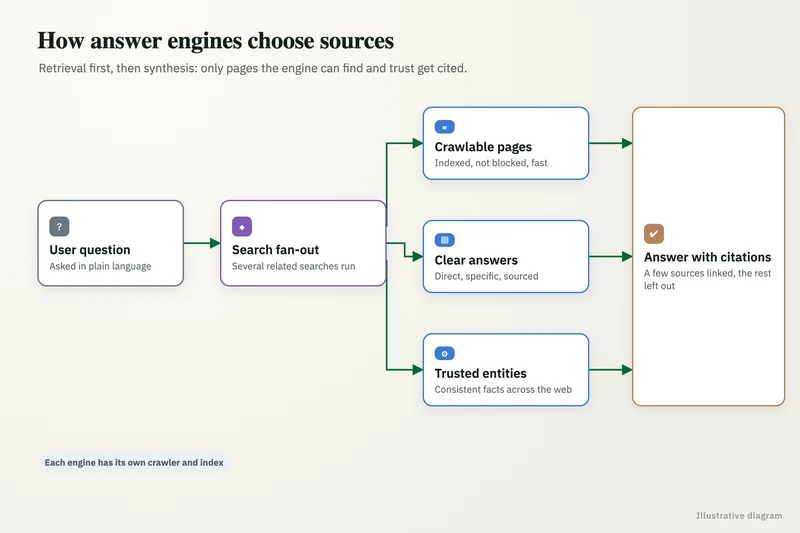
How to rank in ChatGPT: what counts as ranking there?
Ranking in ChatGPT means being named, quoted or linked when it answers a question in your category. There is no numbered list of ten results; there is an answer that mentions some brands and cites some sources, and the rest are invisible.
That matters because of scale. TechCrunch reported in February 2026 that ChatGPT had 900 million weekly active users. When one of them asks for the best accounting software for a small agency, the brands in the reply are the shortlist. Your goal is to be in that reply, described accurately, with a link to a page that helps the buyer take the next step.
There are two ways to appear. ChatGPT can cite your pages when it searches the web, and it can mention your brand from what it already knows. AEO work targets both, but the first is where you have the most direct control. Brand knowledge inside the model changes slowly and reflects what the wider web has said about you over time, which is another reason the mention work in later sections pays off on both fronts.
How does ChatGPT choose which sources to cite?
OpenAI does not publish how ChatGPT ranks sources, so the honest answer is that nobody outside OpenAI knows the full method. What is documented is how its crawlers work, and what is observable is which domains it cites.
Results also shift between modes. Semrush found that only 25% of cited sources overlap between ChatGPT's reasoning modes, so the same question can surface different pages depending on how a user asks and which mode runs. That is why we never judge progress on a single prompt. We run a fixed prompt set, in several phrasings, and look at the pattern across all of them.
Can ChatGPT's crawlers reach your website?
Check this first, because it is the most common silent failure. According to OpenAI's crawler documentation, sites that opt out of OAI-SearchBot are not shown in ChatGPT search answers, and robots.txt changes take about 24 hours to apply.
OpenAI runs separate agents for separate jobs, and many sites block the wrong one. Blocking GPTBot only opts you out of model training; it does not affect search. Blocking OAI-SearchBot removes you from search answers. Cloudflare changed its default on 1 July 2025 to block AI crawlers unless they pay, so a site on Cloudflare can block ChatGPT search without anyone on the marketing team choosing to. Review the AI crawler settings in the Cloudflare dashboard and confirm in your server logs that OAI-SearchBot requests return HTTP 200.
| OpenAI agent | What it does | Recommended setting for visibility |
|---|---|---|
| OAI-SearchBot | Surfaces sites in ChatGPT search; follows robots.txt | Allow |
| GPTBot | Collects training data; blocking opts out of training only | Your choice; does not affect search |
| ChatGPT-User | Fetches pages when a user asks; not used for indexing | Allow; may not follow robots.txt |
| OAI-AdsBot | Checks submitted ads | Relevant only if you run ads |
How do you write pages that ChatGPT can quote?
Put the answer first, in plain words, under a heading that matches the question. ChatGPT builds replies from passages, and a passage that answers cleanly in its opening lines is easier to use than one that warms up for three paragraphs.
Serve the content as HTML from the server rather than relying on client-side JavaScript, so a crawler that does not run scripts still sees the text. Add visible last-updated dates, since buyers ask about current prices and features. Keep Organization schema accurate and matching the page, with sameAs links to your official profiles; it will not force a citation, but it keeps your facts consistent.
- Question-style H2s that mirror real buyer prompts, each opened by a one or two sentence answer.
- Comparison and alternatives pages that lay out trade-offs honestly, including where a competitor fits better.
- Pricing, integration and specification pages with concrete, current facts.
- FAQ blocks where every answer makes sense on its own.
- Original data, such as a benchmark or survey, that other sites will want to reference.
Why do mentions on other sites matter for ChatGPT?
Because ChatGPT cites other websites about you at least as often as it cites you. Semrush's research found Wikipedia and Reddit remain among its top sources, and Peec AI's analysis of 30 million sources lists Reddit, YouTube, LinkedIn, Wikipedia, Forbes, G2 and Yelp among the most-cited domains in AI search.
Source mix also moves quickly. Semrush tracked ChatGPT citing Reddit in about 60% of responses, then about 10% within weeks between August and September 2025. Chasing one platform is fragile; a broad, genuine presence is more stable.
In practice that means accurate profiles on the review sites your category uses, real participation in relevant Reddit communities, useful YouTube content, founder and expert posts on LinkedIn, and coverage in trade publications. Google's guide warns against inauthentic mentions, and fake reviews or planted threads also tend to be spotted by the communities themselves. Earn the mentions; do not manufacture them.
How to get cited by ChatGPT for best-of and comparison prompts?
Make sure the pages ChatGPT reads for those prompts mention you, and that your own site answers the comparison directly. Prompts such as "best CRM for a 20-person sales team" or "X vs Y" pull heavily from roundups, review platforms and comparison pages.
Start by running those prompts yourself and noting which URLs ChatGPT cites. Those are the pages to be on: request inclusion in relevant roundups with real information, keep your G2 or Capterra profile complete, and publish your own comparison pages that are fair enough to be useful. A one-sided page that claims you win on every point is less likely to be quoted than one that says plainly who each product suits.
How do you fix wrong information ChatGPT gives about your brand?
Correct the sources it draws on, not the chatbot. ChatGPT tends to repeat what the web says, so outdated pricing, a former product name or a wrong headquarters city usually traces back to an old directory listing, a stale Wikipedia or Wikidata entry, or an old article.
Run prompts that ask ChatGPT to describe your company, note every error and the sources cited alongside it, then fix those sources one by one. Update your own About, pricing and product pages with clear, dated statements. Align your company details across Wikidata, review sites, Google Business Profile and LinkedIn. Then re-run the same prompts monthly to see whether the description changes.
How do you track whether you are showing up in ChatGPT?
Use two measures: referral traffic and a prompt test. In GA4, chatgpt.com appears as a referral source; group it with perplexity.ai, copilot.microsoft.com and gemini.google.com into an AI channel so the trend is visible.
Traffic alone undercounts, because many buyers read the answer and never click. So we keep a fixed prompt set built from real buyer questions, run it in ChatGPT on a monthly schedule, and record whether your brand is mentioned, whether your URLs are cited and how you are described. Paid tools such as Otterly.AI or Semrush's AI Visibility Toolkit can automate part of this. No one can promise a citation on any single prompt, but a rising share across the set is a reliable sign the work is landing.
FAQ
Frequently asked questions
Does blocking GPTBot remove me from ChatGPT search?
No. OpenAI's documentation says GPTBot collects training data and blocking it only opts you out of training. ChatGPT search visibility depends on OAI-SearchBot, a separate crawler. If you want to appear in ChatGPT search answers, keep OAI-SearchBot allowed in robots.txt and in your CDN settings.
Does ChatGPT use Bing to find websites?
OpenAI has not published how ChatGPT ranks or retrieves sources, so treat claims about a specific search partner with care. What OpenAI does document is its own crawler, OAI-SearchBot, which surfaces sites in ChatGPT search. Making sure that crawler can reach your pages is the safest first step.
How long does it take to show up in ChatGPT?
Crawler changes apply quickly; OpenAI says robots.txt updates for OAI-SearchBot take about 24 hours. Content and mention work takes longer to show, because ChatGPT has to recrawl pages and other sites have to write about you. Track a fixed prompt set monthly to see the trend.
Can I pay for placement in ChatGPT answers?
There is no published way to buy placement in ChatGPT's organic answers. OAI-AdsBot exists to check submitted ads, which is separate from the cited sources in an answer. Organic citations come from accessible pages, clear answers and genuine mentions, and no one can promise one.
Do I need an llms.txt file to appear in ChatGPT?
No. No major answer engine, OpenAI included, has confirmed using llms.txt when choosing sources, and Google's John Mueller compared it to the meta keywords tag. It is cheap to publish and can help coding agents read developer docs, but crawler access, clear pages and genuine mentions matter far more for ChatGPT.
Does schema markup help me rank in ChatGPT?
There is no evidence that schema is a direct lever for ChatGPT citations. It does keep your company facts consistent and machine-readable, which supports accurate descriptions. Use Organization schema with sameAs links where it matches visible content, then spend most of your effort on answers and mentions.
Keep reading
Related pages
Get started
Find out what AI says about you
Send your website and three questions your buyers ask. Within one business day we reply with how ChatGPT, Google AI Overviews and Perplexity answer them today, who they cite instead of you, and a fixed-price plan.
- Free AEO visibility check
- Fixed quote before any work starts
- Measured on citations and AI referrals, not promises
Prefer email? info@aeoservicesagency.com
Get a free AEO visibility check
Two lines is enough to start.