

Ecommerce
AEO for ecommerce stores that want their products named in AI answers
AEO for ecommerce means giving ChatGPT, Google AI Overviews, AI Mode, Perplexity and Copilot clean, crawlable product and category information so that when a shopper asks what to buy, your store is one of the answers. We work with ecommerce managers, DTC founders and growth leads running Shopify, WooCommerce, BigCommerce or custom storefronts. The work covers product pages, feeds, reviews, category and buying-guide content, crawler access and tracking of AI referral revenue in GA4.
Get a free AEO visibility check
Two lines is enough. A specialist replies within one business day.
Quick answer
How do ecommerce brands get their products recommended by AI assistants?
AEO for ecommerce works by making product data easy for answer engines to read and trust: server-rendered product pages with prices and specs in text, product schema that matches what shoppers see, an accurate Merchant Center feed, genuine reviews, and category pages that answer buying questions. Then track product prompts and AI referral revenue every month.
- AI referral traffic to US retail sites has grown sharply since the 2025 holiday season.
- Product data must agree across the page, the schema, the feed and marketplaces.
- Category pages and buying guides answer the comparison questions shoppers ask assistants.
- We measure AI referral sessions, add-to-carts and revenue in GA4, month by month.
Are shoppers really finding products through AI assistants?
Yes, and the volume is climbing fast from a small base. Adobe reported that AI traffic to US retail sites rose 693% during the 2025 holiday season, and TechCrunch, citing Adobe data, reported a 393% rise in Q1 2026.
The questions shoppers ask are long and specific: a waterproof trail shoe for wide feet under a set budget, a gift for a ten-year-old who likes chemistry, a moisturizer without fragrance for sensitive skin. Answers to prompts like these pull from product pages, category pages, review content and forums. If your catalog is thin on text, the assistant fills the gap with someone else's store.
What makes a product page something an assistant can quote?
Specific, visible facts. A product page that states materials, dimensions, compatibility, care instructions, shipping times and return terms in plain text gives an answer engine something to repeat; a page with a hero image, a price and "add to cart" gives it nothing.
We add a short answer-first summary near the top of key product pages, a specification table, and an FAQ block drawn from real customer questions in your support inbox. Product schema stays in place for rich results, but Google's AI optimization guide is clear that no special markup is required for AI features, and its guidance says structured data must match the visible content. So we check that price, availability and rating in the schema agree with the page.
What you get
What we deliver
Scoped and quoted at a fixed price after a free review.
Product prompt baseline
Shopping prompts for your top categories run in each assistant, with the stores and products currently named.
Product page upgrades
Answer-first summaries, spec tables and customer FAQ blocks on your highest-margin products.
Feed and schema check
Merchant Center feed, product schema and visible page data compared field by field, with mismatches fixed.
Category and guide content
Category intros and buying guides written to answer comparison prompts, each with an author and update date.
Crawler and rendering review
robots.txt, Cloudflare rules and server logs checked so answer-engine crawlers see prices, stock and reviews.
AI revenue report
Monthly GA4 view of AI referral sessions, conversion rate and revenue next to citation share.
How do product feeds and Merchant Center fit into AEO for ecommerce?
They are the structured copy of your catalog, and they need to agree with the site. Google Merchant Center feeds supply titles, prices, availability and identifiers like GTINs to Google's shopping surfaces, so a stale feed and an up-to-date product page send mixed signals about the same item.
We audit feed titles and attributes against product pages, fix mismatched prices and out-of-stock items still marked available, and align product naming across the site, Amazon or other marketplace listings and your Google Business Profile if you have physical stores. On ChatGPT shopping results specifically, OpenAI does not publish how it chooses products, so we focus on the inputs any engine can read: accurate pages, consistent data and real reviews.
Why do category pages and buying guides carry so much weight?
Because most shopping prompts are comparisons, not product lookups. "Best espresso machine for a small kitchen" is answered from pages that compare options and explain trade-offs, which on most stores means the category page or a buying guide.
Many Shopify category pages are a grid of tiles with one line of text. We add an opening paragraph that says who the range suits, short sections answering the questions buyers ask in that category, filters that resolve to crawlable URLs, and links to a buying guide written by someone who knows the products. Each guide gets a named author and a last-updated date.
- Category intros that answer "which one should I buy" in two sentences
- Buying guides built around sizing, compatibility and use case
- Comparison tables between your own top sellers
- FAQ blocks pulled from returns reasons and support tickets
Is your storefront setup hiding products from AI crawlers?
It can be, without anyone noticing. Headless storefronts that load price and stock through client-side JavaScript, apps that inject reviews after the page loads, and Cloudflare bot rules can all leave crawlers with an empty product shell.
Cloudflare's own blog says it changed its default on 1 July 2025 to block AI crawlers unless they pay, so stores on Cloudflare should check which bots are allowed. We review robots.txt, the Cloudflare AI crawler settings and server logs to confirm OAI-SearchBot, PerplexityBot, Claude-SearchBot, Bingbot and Googlebot fetch product and category URLs and receive full HTML. Training-only tokens such as GPTBot and Google-Extended are a separate business decision we help you make.
How should an online store track AI visibility and revenue?
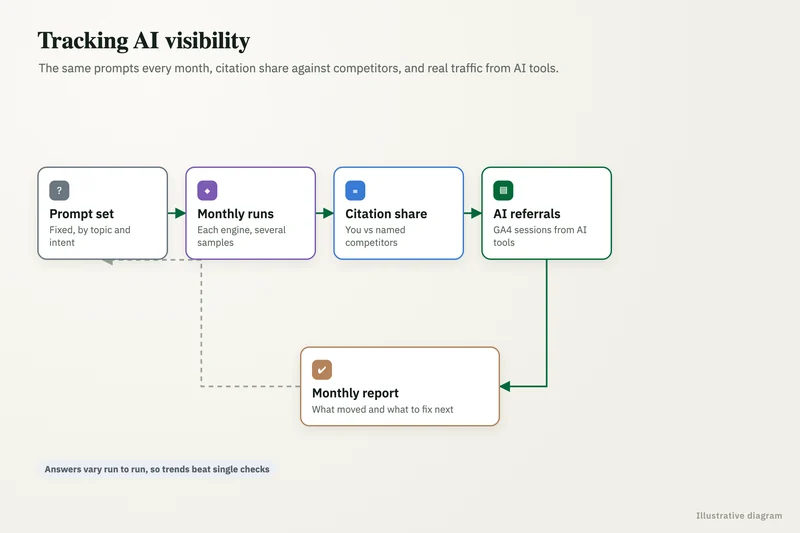
Track the prompts and the money separately, then connect them. A fixed set of product and category prompts is run monthly in ChatGPT, Perplexity, Copilot, Gemini and Google AI Mode, recording which stores and products are named.
In GA4 we group chatgpt.com, perplexity.ai, copilot.microsoft.com and gemini.google.com as AI referral sources and report sessions, add-to-cart rate and revenue for them. Search Console's generative AI report and Bing Webmaster Tools AI Performance add first-party impression and citation data. Reddit threads and YouTube reviews that mention your products are logged too, since those platforms appear among the most cited domains in Peec AI's research.
How it works
How an engagement runs
- 01
Free visibility check
We test a sample of shopping prompts for your categories and quote a fixed price for the work.
- 02
Catalog audit
Product, category, feed and crawler review, ranked by revenue at stake.
- 03
Fix and publish
Product pages, category content and technical fixes ship in priority order, starting with top sellers.
- 04
Monthly tracking
Same prompts, same engines each month, reported next to GA4 revenue from AI referrals.
FAQ
Frequently asked questions
Does product schema help products show up in AI answers?
Google says no special schema is required for its AI features, but product schema still supports rich results and general SEO. The bigger risk is schema that disagrees with the page, such as an old price or a wrong stock status, so we check that the markup matches what shoppers see.
How does ChatGPT choose which products to recommend?
OpenAI does not publish how ChatGPT ranks sources or products. What a store can control is whether its pages are crawlable by OAI-SearchBot, whether product facts are written out clearly, and whether reviews and third-party mentions describe the products accurately.
Is AEO for ecommerce worth it for a small Shopify store?
It can be, because the first fixes are often cheap: allowing the right crawlers, adding text to category pages and correcting feed data. Smaller stores with a clear niche can be easier for assistants to describe than broad marketplaces.
Do reviews on our site affect AI recommendations?
Reviews give answer engines concrete descriptions of fit, quality and problems, written by buyers. Make sure they load as crawlable HTML rather than only through a script, and never add fake reviews; Google's AI optimization guide advises against inauthentic mentions of any kind.
Should an online store block GPTBot?
Blocking GPTBot only opts your content out of OpenAI model training, according to OpenAI's crawler documentation. It does not remove you from ChatGPT search, which relies on OAI-SearchBot, so many stores block training bots while keeping search bots allowed.
How do we see AI shopping traffic in Google Analytics?
In GA4, look for referral sources such as chatgpt.com, perplexity.ai, copilot.microsoft.com and gemini.google.com, then group them into a custom channel. That lets you compare their conversion rate and revenue with organic search.
Keep reading
Related pages
Get started
Find out what AI says about you
Send your website and three questions your buyers ask. Within one business day we reply with how ChatGPT, Google AI Overviews and Perplexity answer them today, who they cite instead of you, and a fixed-price plan.
- Free AEO visibility check
- Fixed quote before any work starts
- Measured on citations and AI referrals, not promises
Prefer email? info@aeoservicesagency.com
Get a free AEO visibility check
Two lines is enough to start.