

Measurement
AI visibility tracking that shows where answer engines name you
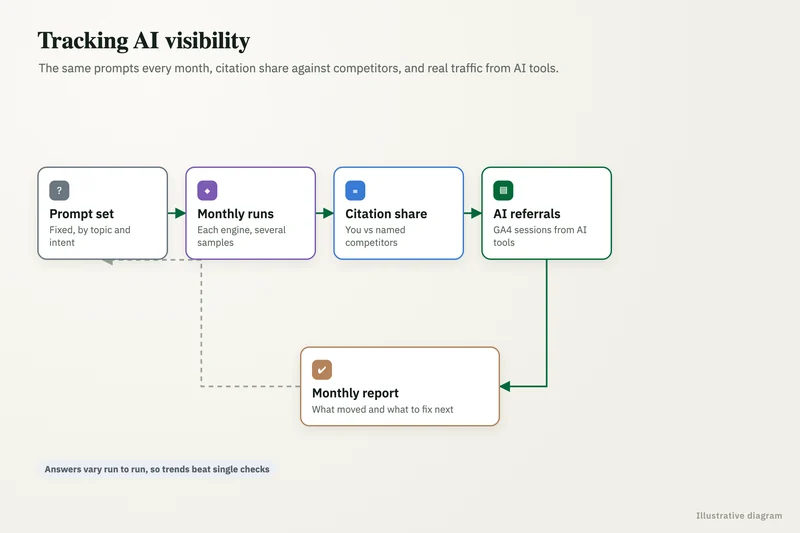
Our AI visibility tracking service measures how often ChatGPT, Google AI Overviews and AI Mode, Perplexity, Copilot, Gemini and Claude mention or cite your brand for the questions your buyers ask. It is for marketing leads who need a number they can defend in a board meeting, not screenshots of a lucky answer. You get a fixed prompt set, monthly runs, citation share against named competitors, AI referral traffic in GA4 and a short report on what changed and why.
Get a free AEO visibility check
Two lines is enough. A specialist replies within one business day.
Quick answer
How do you track your brand's visibility in AI answers?
AI visibility tracking means running a fixed set of real buyer prompts through each answer engine on a schedule, recording whether your brand is mentioned or cited and which sources appear instead, then pairing that with first-party data from Search Console, Bing Webmaster Tools and GA4. The trend across months matters more than any single answer.
- A fixed prompt set, run the same way each month, is the base of honest measurement.
- Search Console and Bing Webmaster Tools now report AI performance for free.
- GA4 referrals from chatgpt.com and perplexity.ai tie AI answers to real sessions and leads.
- Single answers vary run to run, so we report trends and ranges, not snapshots.
What does AI visibility tracking actually measure?
It measures presence, prominence and accuracy: whether you appear, how you appear and whether what the engine says is true. Rankings alone cannot show any of that, because there is no position one in a generated paragraph.
For each prompt and engine we record a small set of fields that stay the same every month, so the numbers can be compared. From those fields we calculate citation share, the percentage of tracked answers that cite your domain, alongside competitor shares for the same prompts.
- Brand mention: does the answer name you at all?
- Citation: is one of your URLs linked as a source, and which one?
- Position and framing: first recommendation, one of several, or a passing note.
- Accuracy: are pricing, locations, features and category described correctly?
- Competing sources: which domains, including Reddit, G2 or review sites, are cited instead.
How do you build a prompt set that reflects real buyers?
Start from the questions buyers ask before they talk to sales, not from keywords you already rank for. We draft them from sales call notes, support tickets, Search Console queries and the follow-up questions answer engines suggest.
A typical set mixes category questions, comparison and alternatives prompts, problem-led questions and branded checks, each tagged by funnel stage and product line. The wording is frozen once agreed, because changing a prompt changes the answer. We also run each prompt more than once and across modes where an engine offers them. Semrush found only 25% of cited sources overlap between ChatGPT's reasoning modes, which is why a single test tells you very little.
What you get
What we deliver
Scoped and quoted at a fixed price after a free review.
Buyer prompt set
An agreed list of real buyer questions, tagged by stage, product line and engine, with frozen wording.
Monthly engine runs
Repeated runs across ChatGPT, AI Overviews and AI Mode, Perplexity, Copilot, Gemini and Claude, with raw answers stored.
Citation share scorecard
Your mention and citation share against named competitors per engine, topic and funnel stage.
GA4 AI channel
A custom channel group for answer engine referrals with landing pages and conversions.
First-party data pull
Search Console generative AI figures and Bing Webmaster Tools AI Performance data in the same view.
Monthly report
A short written summary of what moved, likely reasons, inaccurate answers found and the next fixes to make.
What can Search Console and Bing Webmaster Tools tell you about AI answers?
More than most teams realize, and both are free. Google counts traffic from AI features inside the Search Console Web search type, and in June 2026 it added generative AI performance reports with impressions and clicks.
On the Microsoft side, the AI Performance report in Bing Webmaster Tools launched in public preview in February 2026 and shows citations across Copilot, Bing AI summaries and partner integrations, with total citations, cited pages and grounding queries. A June 2026 update added Intents, Topics, Citation Share and Compare. We pull these first-party figures into the same report as our prompt runs, so tool estimates are always checked against platform data.
How do you see AI referral traffic in GA4?
Create a custom channel group that captures referrals from answer engine domains, then report sessions, engaged sessions and conversions for it. Without that step, AI visits sit unnoticed inside the general referral bucket.
We match source domains including chatgpt.com, perplexity.ai, copilot.microsoft.com and gemini.google.com, and break results down by landing page. That shows which pages answer engines actually send people to, which is often a different list from your top organic pages. Server logs add a further signal: ChatGPT-User and Perplexity-User requests appear when a person's question causes the engine to fetch your page in real time.
Which AI citation tracking tools are worth paying for?
It depends on how many prompts and engines you need, and we stay tool-neutral. Published pricing pages show a wide spread, from small prompt bundles to enterprise contracts.
We can run tracking inside your existing subscription or our own, and we always reconcile tool output with Search Console and Bing data. Peec AI is another option we work with, though we do not quote its price because we could not confirm it.
- Otterly.AI: daily tracking on ChatGPT, AI Overviews, Perplexity and Copilot; Lite is listed at $29 for 15 prompts.
- Semrush AI Visibility Toolkit: listed as a $99 per month add-on covering 25 prompts.
- Ahrefs Brand Radar: custom prompts listed from €47 per month.
- Scrunch: Starter listed at $300 per month, with agent-traffic attribution.
- Profound: tracking across up to 9 engines, with a 7-day trial and custom enterprise pricing.
How often do AI answers change, and how should you read the trend?
They change often enough that monthly trends beat weekly alarms. Semrush tracked ChatGPT citing Reddit in about 60% of responses before that fell to about 10% within weeks in August and September 2025, a shift no single brand caused.
So we report a three-month rolling view, flag movements larger than normal run-to-run noise, and tie each change to something concrete where we can: a page update, a new third-party review, a crawler block or an engine-side shift seen across all tracked brands. When nothing explains a move, we say so rather than inventing a story.
How it works
How an engagement runs
- 01
Agree the prompts
We draft the prompt set with your sales and marketing leads and freeze the wording.
- 02
Set the baseline
We run every prompt across each engine several times and record the starting citation share.
- 03
Connect your data
We set up the GA4 channel group and pull Search Console and Bing Webmaster Tools access.
- 04
Run and report monthly
We repeat the runs on a fixed schedule and send a scorecard plus a short commentary.
- 05
Review the set quarterly
We add prompts for new products or competitors while keeping the core set comparable.
FAQ
Frequently asked questions
What is citation share in AI search?
Citation share is the percentage of tracked AI answers that cite your website as a source. Bing Webmaster Tools added a Citation Share view to its AI Performance report in June 2026 for Copilot and Bing. We calculate the same measure across other engines using a fixed prompt set.
Can I see AI Overview traffic in Google Search Console?
Yes. Google counts AI feature traffic within the Web search type, and in June 2026 it added generative AI performance reports showing impressions and clicks. These figures cover Google only, so ChatGPT and Perplexity need separate tracking.
What tools track ChatGPT mentions of my brand?
Tools such as Profound, Semrush AI Visibility Toolkit, Ahrefs Brand Radar, Otterly.AI, Scrunch and Peec AI track brand mentions and citations in ChatGPT and other engines. Their prompt limits and engine coverage differ, so the right choice depends on how many questions you need to monitor.
How many prompts should an AI brand visibility program track?
Enough to cover your main categories, comparisons and buyer problems without losing the ability to act on the results. For many businesses that means a few dozen to a hundred prompts. Fewer, well-chosen prompts run consistently beat a huge set nobody reads.
Why does ChatGPT give a different answer each time I ask?
Generated answers vary between runs, modes and sessions, and the sources behind them shift too. Semrush found only 25% of cited sources overlap between ChatGPT's reasoning modes. That is why one manual check proves little and repeated, structured runs are needed.
Is AI visibility tracking useful without other AEO work?
Yes, as a baseline. Many teams start with tracking alone to learn where they stand before funding content or technical changes. It also shows whether any later work moved the numbers, which is the only fair way to judge an AEO program.
Keep reading
Related pages
Get started
Find out what AI says about you
Send your website and three questions your buyers ask. Within one business day we reply with how ChatGPT, Google AI Overviews and Perplexity answer them today, who they cite instead of you, and a fixed-price plan.
- Free AEO visibility check
- Fixed quote before any work starts
- Measured on citations and AI referrals, not promises
Prefer email? info@aeoservicesagency.com
Get a free AEO visibility check
Two lines is enough to start.