

Checklist
AEO checklist: the checks we run before any AI search work
This AEO checklist lists the checks that decide whether ChatGPT, Google AI Overviews and AI Mode, Perplexity, Copilot, Gemini and Claude can find, trust and cite your site, grouped in the order they should be fixed. It is for marketing leads and in-house SEO teams running their own review, and it doubles as an AEO audit checklist you can hand to an agency to see what their audit leaves out.
Get a free AEO visibility check
Two lines is enough. A specialist replies within one business day.
Quick answer
What should an AEO checklist include?
A complete AEO checklist covers six areas in order: crawler access (robots.txt, Cloudflare, server logs), indexing and snippet eligibility in Google and Bing, answer-first content, entity consistency (schema and profiles), third-party mentions, and measurement against a fixed prompt set. Fix access first, because nothing else matters if engines cannot fetch your pages.
- Work in order: access, indexing, content, entities, mentions, measurement.
- Check every search crawler token, and Cloudflare, not just robots.txt.
- Each content section should open with a direct one or two sentence answer.
- Baseline a fixed prompt set before changing anything, then re-run monthly.
How should you use this AEO checklist?
Run it top to bottom and fix in the same order, because each group depends on the one before. A beautifully structured page earns nothing if OAI-SearchBot gets a 403 from your CDN.
Record each check as pass, fail or not applicable, with the evidence: a screenshot, a log line, a URL. That record becomes your baseline. Start by taking the measurement snapshot in the last group, so that any later change in citations can be compared against where you began.
The checklist is written for a typical business website. Ecommerce sites should add product feed checks, local businesses should add Google Business Profile and directory checks, and regulated industries should add review and compliance steps before publishing.
Can AI crawlers reach your site?
Check that every search and answer crawler can fetch your key pages, both in robots.txt and at the CDN or firewall. This is the most common silent failure.
Cloudflare changed its default in July 2025 to block AI crawlers unless they pay, and in June 2026 said AI training crawlers would be blocked by default on all new domains. Training blocks are a valid choice, but confirm the search crawlers are not caught by the same rule.
Read the crawler documentation rather than guessing from names. OpenAI says OAI-SearchBot decides whether a site can appear in ChatGPT search answers and that robots.txt changes take about 24 hours, while GPTBot only gathers training data. Perplexity-User and ChatGPT-User fetch pages when a user asks and may not follow robots.txt, so blocking them in robots.txt alone may not work as expected.
- robots.txt allows Googlebot, Bingbot, OAI-SearchBot, PerplexityBot, Claude-SearchBot and Applebot.
- Training tokens (GPTBot, ClaudeBot, Google-Extended, Applebot-Extended, CCBot) reflect a deliberate decision.
- Cloudflare AI crawler and managed robots.txt settings reviewed and documented.
- Server logs show search crawlers receiving HTTP 200, not 403 or 402.
- Key content renders in the HTML response, not only after JavaScript runs.
Are your pages indexed and eligible for AI answers?
Confirm key pages are indexed in Google and Bing and eligible to show a snippet. Google says that is all its AI features require, with no additional technical requirements.
Bing matters beyond its own results, because Bingbot does the crawling for Copilot. Submitting changes through IndexNow and sitemaps keeps both engines current.
- Google Search Console: key URLs indexed, no unintended noindex or canonical errors.
- Pages you want quoted are eligible to show a snippet, with no snippet restrictions.
- Bing Webmaster Tools verified; key URLs indexed.
- XML sitemap current, with accurate lastmod dates; IndexNow set up for changes.
- Canonical URLs consistent across internal links, sitemaps and hreflang where used.
Is your content written answer-first?
Check that each important page answers its main question in the first one or two sentences, under a heading phrased as the question. Engines quote passages, so each section should stand on its own.
Freshness counts. In an Ahrefs study of "best X" lists cited by ChatGPT, 79.1% had been updated in 2025, so a visible last-updated date and current figures are part of the checklist, not decoration.
Check the pages your buyers' prompts are most likely to hit first: pricing, comparison, alternatives, category and how-to pages. These are the pages an AEO checklist should review line by line, because they map directly to the questions people ask assistants before they shortlist a vendor.
- H2s phrased as the questions buyers ask, drawn from real prompts and Search Console queries.
- A direct one or two sentence answer opens each section.
- Comparisons are in tables; definitions are stated plainly.
- Statistics name their source in the sentence.
- Visible last-updated date on guides, pricing and comparison pages.
- FAQ answers make sense without the question above them.
Are your brand facts consistent everywhere?
Check that your name, description, products, locations and leadership read the same on your site, in your schema and on every major profile. Inconsistency gives models conflicting facts to blend.
Google says structured data must match visible content and is not required for generative AI search, so treat schema as a consistency tool rather than a citation lever.
- Organization schema with name, logo, URL and sameAs links to official profiles.
- LinkedIn, Wikipedia (if an entry exists), Wikidata and Crunchbase-style profiles match the site.
- Industry profiles current: G2 and Capterra for software, Google Business Profile and Yelp for local, legal directories for law firms.
- Name, address and phone identical across listings for local businesses.
- Old product names, prices and addresses removed or redirected.
Do trusted third parties mention you?
Check where the answers to your buyers' prompts come from, and whether you appear in those sources. Off-site mentions often decide who gets named.
Ahrefs found that web mentions correlate 0.664 with AI Overview visibility, against 0.218 for backlinks, across 75,000 brands. Yext's analysis of 6.8 million citations found 44% came from brands' own websites and 42% from listings, so both your pages and your listings carry weight. Google advises against inauthentic mentions, so every item below means earned or accurate coverage, not seeded posts.
- Recent genuine reviews on the platforms your industry's answers cite.
- Presence in the editorial and comparison lists that appear for your category prompts.
- Reddit and YouTube: real discussions or videos that mention you accurately.
- LinkedIn and press coverage of original data or expertise.
- No bought reviews or undisclosed paid placements.
What should an AEO audit checklist include for measurement?
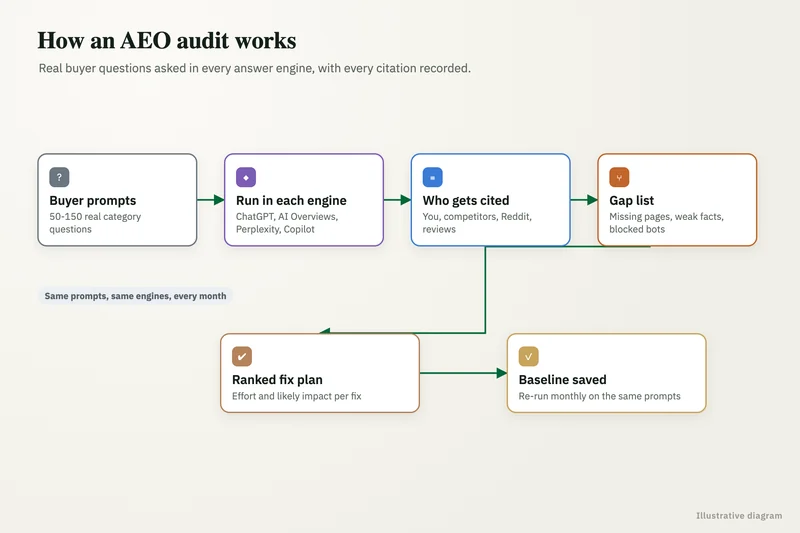
A baseline that you can re-run: a fixed prompt set, first-party AI reports and AI referral tracking. Without it, no later claim of progress can be checked.
Google added generative AI performance reports to Search Console in June 2026, and Bing Webmaster Tools AI Performance shows Copilot citations and citation share. Answers vary between runs, so sample each prompt more than once and read monthly trends.
- 25 to 100 buyer prompts written by topic and intent, saved and fixed.
- Each prompt run in ChatGPT, AI Overviews or AI Mode, Perplexity, Copilot and Gemini; mentions and cited URLs logged.
- Search Console generative AI report and Web search type exported as a baseline.
- Bing Webmaster Tools AI Performance baseline saved.
- GA4 segment for chatgpt.com, perplexity.ai, copilot.microsoft.com and gemini.google.com.
- A change log recording every fix and its date.
How do you check each item quickly?
Most checks take minutes with tools you already have. The table maps each group to where you look and what a pass looks like.
| Group | Where to check | Pass looks like |
|---|---|---|
| Crawler access | robots.txt, Cloudflare dashboard, server logs | Search crawlers allowed and receiving 200 responses |
| Indexing | Search Console, Bing Webmaster Tools, sitemap | Key pages indexed and snippet-eligible in both |
| Content | Page review against target prompts | Question H2s, direct answers, tables, dates |
| Entities | Schema output, LinkedIn, review and directory profiles | Same facts everywhere; sameAs links resolve |
| Mentions | Cited URLs from your prompt runs | You appear in the sources engines already cite |
| Measurement | Prompt log, Search Console, Bing, GA4 | Baseline saved; monthly re-run scheduled |
What should you do after the checklist?
Rank the failures by impact and effort, fix access and indexing at once, then schedule content, entity and mention work by the prompts that matter most. Re-run the prompt set monthly.
Keep the evidence from each check with the date it was taken. When a CDN rule changes, a migration resets canonicals or a profile goes stale, the dated record shows exactly what broke and when, which is far faster than auditing from scratch.
If you want a second pair of eyes, AEO Services Agency, the AEO and GEO practice of Greenwolf Tech Labs, offers a free AEO visibility check. Any follow-on work is quoted at a fixed price, and we measure the same prompt set before and after changes so the results can be verified. No one can promise a citation; a checklist done properly gives you the best odds and the evidence to judge.
FAQ
Frequently asked questions
What is the first thing to check in an AEO audit?
Crawler access. Confirm robots.txt and your CDN, especially Cloudflare, allow Googlebot, Bingbot, OAI-SearchBot, PerplexityBot and Claude-SearchBot, and that server logs show them receiving HTTP 200 responses. Content work cannot help pages that engines cannot fetch.
Does the AEO checklist include llms.txt?
Only as optional hygiene. No major answer engine has confirmed using llms.txt, and Google's John Mueller compared it to the meta keywords tag. It does no harm, but it should never sit above crawler access or content on a priority list.
How often should I run an AEO checklist?
Run the full checklist once as a baseline and again after major site changes such as a migration or CDN change. Re-run the measurement section monthly, since AI answers and cited sources shift often.
Is schema markup required for AEO?
No. Google says structured data is not required for generative AI search and there is no special schema to add. It still helps general SEO and keeps entity facts clear, so keep Organization schema accurate and matching visible content.
Can I run an AEO audit checklist without paid tools?
Yes. robots.txt, server logs, Cloudflare settings, Search Console, Bing Webmaster Tools and GA4 cover most checks for free. A paid prompt tracker saves time on the measurement section but manual monthly prompt runs work for a small set.
How long does it take to work through an AEO checklist?
A small site can complete the access, indexing and measurement checks in a day or two using free tools. Content, entity and mention items take longer because they involve rewriting pages and contacting third parties, so plan those over several weeks and track them in a change log.
Keep reading
Related pages
Get started
Find out what AI says about you
Send your website and three questions your buyers ask. Within one business day we reply with how ChatGPT, Google AI Overviews and Perplexity answer them today, who they cite instead of you, and a fixed-price plan.
- Free AEO visibility check
- Fixed quote before any work starts
- Measured on citations and AI referrals, not promises
Prefer email? info@aeoservicesagency.com
Get a free AEO visibility check
Two lines is enough to start.