

Traffic recovery
AI Overviews traffic drop: find the real cause, then win clicks back
An AI Overviews traffic drop usually shows up as steady impressions and falling clicks on queries where Google now answers above the results. This page is for marketing and SEO leads who need to know how much of a decline AI Overviews caused, how much came from other factors, and what can realistically be won back. You get a query-level diagnosis and a page plan aimed at being cited inside the overview rather than buried beneath it.
Get a free AEO visibility check
Two lines is enough. A specialist replies within one business day.
Quick answer
How do you recover from an AI Overviews traffic drop?
Recovering from an AI Overviews traffic drop starts with confirming the cause in Search Console: flat impressions and position with falling click-through rate on informational queries point to AI Overviews. Then rework the affected pages with direct answers, definitions, steps and tables so they are cited inside the overview, and track cited queries separately.
- Steady impressions with falling clicks is the typical overview pattern; falling position is something else.
- Some lost clicks were never customers; recovery effort goes to queries needing more than a summary.
- Being cited inside the overview is the realistic target, not ranking above it.
- Search Console's generative AI report gives first-party numbers for AI features.
Is your AI Overviews traffic drop really caused by AI Overviews?
Often partly, rarely entirely. Before rewriting anything we separate four causes, because each needs a different fix:
- Click-through erosion: impressions and average position hold while clicks fall. This is the overview signature.
- Ranking loss: position drops with clicks, pointing to a core update, competitor gains or a technical fault.
- Demand change: impressions fall as well, which suggests seasonality or a shrinking topic.
- Measurement change: consent banners, tracking edits or redirects altering what GA4 records.
How much do AI Overviews reduce clicks?
Enough to matter, though the size depends on the query. Pew Research found users clicked a result on 8% of visits that showed an AI summary, against 15% of visits without one, based on browsing by 900 US adults in March 2025.
Google's own data tells a different story. Liz Reid of Google wrote in August 2025 that organic clicks were relatively stable year on year, with slightly more quality clicks. Both can hold at once: total clicks across the web stay level while specific informational queries lose most of their traffic. Your Search Console export decides which picture describes your site.
What you get
What we deliver
Scoped and quoted at a fixed price after a free review.
Traffic drop diagnosis
A Search Console and GA4 analysis splitting the decline into overview erosion, ranking loss, demand change and tracking issues.
Query segmentation
Affected queries sorted into recoverable and summary-only groups, with the value of each estimated from your conversion data.
Overview citation baseline
A record of which pages Google's AI Overviews and AI Mode currently cite for your priority queries.
Page rework briefs
For each priority page, the answer to lead with, the sub-questions to add and the tables or steps to build.
Technical checks
Snippet eligibility, indexing status and structured data accuracy for every page in the plan.
Monthly recovery report
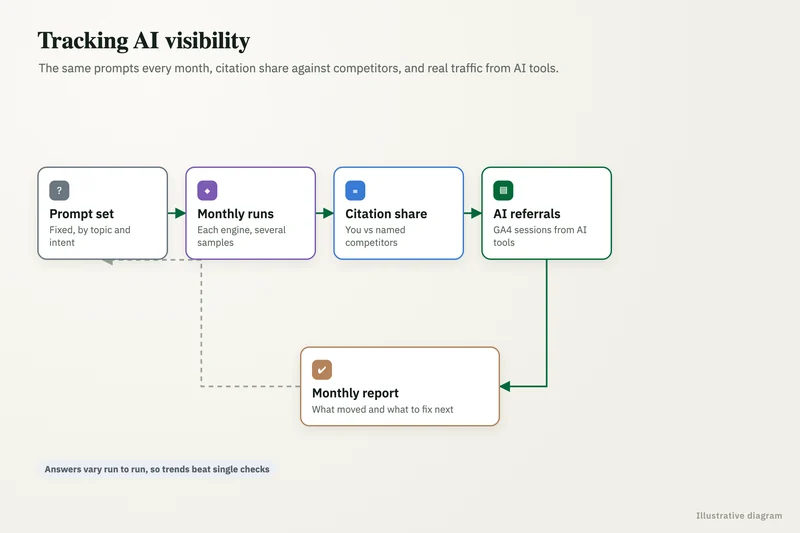
Clicks, click-through rate and citation status for the affected group, alongside AI referrals and conversions.
Which pages does Google cite in an AI Overview?
Pages that are indexed, eligible for a snippet and answer a sub-question cleanly. Google's documentation says AI features have no additional requirements beyond that. Because AI Overviews can use query fan-out, a page may be cited for one subtopic of a search even when it does not rank for the main query.
That is where recovery lives. Seer Interactive's April 2026 update, covering 53 brands, found pages cited in the overview earned 120% more clicks per impression than pages that were not. Seer's published Trex case study listed the tactics behind its gains: direct answers, definitions, step lists, comparison tables and internal links.
What traffic can and cannot be recovered?
Some lost clicks are gone for good. A searcher who wanted a one-line definition got it from the overview and was rarely a likely customer, so chasing that click wastes budget.
What can be recovered is the visit from someone who needs more than a summary: a process to follow, a comparison to weigh, a price, a calculator, a local option. We sort affected queries into those two groups, spend effort on the second, and make sure your brand is at least named in the first. Some of the demand also moves to assistants, which is why AI referrals belong in the same report.
A useful test for each query is to read the overview yourself and ask what a serious buyer would still need. If the honest answer is nothing, mark it summary-only and move on; if it is a decision, a number or a nearby provider, the page that supplies it has a case for the click.
What do we change on the affected pages?
We restructure existing pages rather than mass-producing new ones. Google's AI optimization guide says optimizing for generative AI search is still SEO and that content does not need to be broken into tiny pieces, so pages stay whole and readable. For each high-value page we:
- Open with a short, direct answer to the query the page lost.
- Add the follow-up questions fan-out tends to explore as H2s, each answered in its first sentence.
- Turn buried processes into numbered steps and option lists into comparison tables.
- Show a last-updated date and refresh any figures that have aged.
- Link to deeper pages and a clear next step, so a cited section leads somewhere useful.
- Confirm structured data matches what is visible, as Google requires.
How is traffic recovery measured?
At query level, with cited and uncited queries tracked apart. AI feature traffic is counted in Search Console's Web search type, and the generative AI performance reports added in June 2026 show impressions and clicks for those features directly. Each month we report clicks, impressions and click-through rate for the affected query group, plus whether your page was cited in the overview during our prompt runs.
We also report AI-referred sessions in GA4 from chatgpt.com, perplexity.ai and gemini.google.com, and conversions from every source. No one can promise a citation; the report shows what moved, on which pages and why.
How it works
How an engagement runs
- 01
Free visibility check
We review a sample of your lost queries, tell you whether AI Overviews look responsible and quote a fixed price.
- 02
Diagnose the drop
A full query-level analysis separates overview losses from other causes.
- 03
Record the baseline
Overview citations and click-through rates are captured for the queries in scope.
- 04
Rework priority pages
Pages are restructured in order of recoverable value, starting with the highest.
- 05
Track and refine
Monthly reports show which reworked pages earned citations and clicks, and the plan shifts accordingly.
FAQ
Frequently asked questions
Why are my impressions steady but clicks down in Search Console?
When impressions and average position hold but clicks fall, an AI Overview answering the query above your result is a likely cause. Check whether the affected queries are informational and whether an overview appears for them before assuming a ranking problem.
Does Search Console show AI Overview traffic separately?
Google counts AI feature traffic within the Web search type, so older reports blend it with ordinary results. In June 2026 Google added generative AI performance reports to Search Console, which show impressions and clicks for AI features on their own.
Should I block Google from using my pages in AI Overviews?
Blocking Google-Extended does not remove you from AI Overviews; Google says that token covers Gemini training and Gemini Apps grounding, while AI Overviews and AI Mode use Googlebot. Blocking Googlebot would remove you from Search entirely, which rarely helps recovery.
Does ranking first still matter when an AI Overview appears?
It still helps, but less than before. Ahrefs has found a falling share of overview citations coming from top-ten results, and Google's fan-out can cite pages for subtopics. Being cited inside the overview has become as important as the position underneath it.
How long does recovery from an AI Overviews traffic drop take?
It varies with how often Google recrawls the reworked pages and how competitive the queries are. We set a baseline first and report monthly, so you see which pages earn citations and clicks back instead of waiting on a single forecast.
Is AI Mode traffic counted the same way as AI Overviews?
Yes. Google's documentation says traffic from its AI features, which include AI Overviews and AI Mode, is counted within the Web search type in Search Console, and the generative AI reports cover them as well.
Keep reading
Related pages
Get started
Find out what AI says about you
Send your website and three questions your buyers ask. Within one business day we reply with how ChatGPT, Google AI Overviews and Perplexity answer them today, who they cite instead of you, and a fixed-price plan.
- Free AEO visibility check
- Fixed quote before any work starts
- Measured on citations and AI referrals, not promises
Prefer email? info@aeoservicesagency.com
Get a free AEO visibility check
Two lines is enough to start.