

Product discovery
ChatGPT shopping optimization: feeds, product pages and proof
ChatGPT shopping is now a product discovery surface rather than an in-chat checkout, and merchants who want their products named need clean feeds, crawlable product pages and independent proof. This page is for ecommerce and DTC teams on Shopify or custom stacks. You get a product-level audit of what ChatGPT recommends in your category today and a plan covering feeds, pages and the other AI shopping channels.
Get a free AEO visibility check
Two lines is enough. A specialist replies within one business day.
Quick answer
How does ChatGPT choose which products to show?
ChatGPT shopping shows organic product results that OpenAI says are not ads. Its help center describes ranking merchants on availability, price, quality and whether the seller is the maker or primary seller. Shopify stores are included through Shopify Catalog, approved partners can submit product feeds, and crawlable product pages with honest reviews strengthen the case.
- OpenAI moved Instant Checkout into Apps in March 2026; discovery is where merchants compete now.
- Availability, price, quality and being the primary seller are the stated merchant signals.
- Feeds are for approved partners; Shopify merchants come in through Shopify Catalog.
- Google, Perplexity and Copilot run their own shopping programs that deserve the same hygiene.
What changed in ChatGPT shopping in 2026?
Checkout moved and discovery stayed. In March 2026 OpenAI moved Instant Checkout out of the chat and into Apps, and Digital Commerce 360 reported OpenAI saying it was prioritizing ChatGPT search and product discovery. The Agentic Commerce Protocol continues, but for most merchants the job is now to be found and recommended rather than to take payment inside a conversation.
That shift changes the plan. Advice written in late 2025 often centered on checkout integration. The question worth money today is whether your product appears when a shopper asks for the 'best moisturizer for dry sensitive skin under $30', and whether the link in that answer goes to your store or to a reseller.
How does ChatGPT decide which merchant to show for a product?
OpenAI's help center says product results are not ads and that merchants are ranked on availability, price, quality and whether they are the maker or primary seller. That wording comes from the help page's published summary; OpenAI has not released a fuller specification.
Two of those signals are in your hands every day. Stock status and price should match across your feed, your product page and your structured data; Google already requires markup to match visible content, and conflicting facts give any comparing system a reason to prefer another source. The maker-or-primary-seller signal is a reason for brands to make their own product pages the most complete source available, ahead of marketplace listings.
What you get
What we deliver
Scoped and quoted at a fixed price after a free review.
Product prompt baseline
Category and product prompts run across ChatGPT, AI Mode, Perplexity and Copilot, recording every product and merchant named.
Feed readiness review
A check of your catalog against OpenAI's feed format and daily snapshot rules, plus Merchant Center diagnostics.
Product page fixes
Price, availability, materials, sizing and Product schema aligned and rendered in HTML that crawlers can read.
Crawler access check
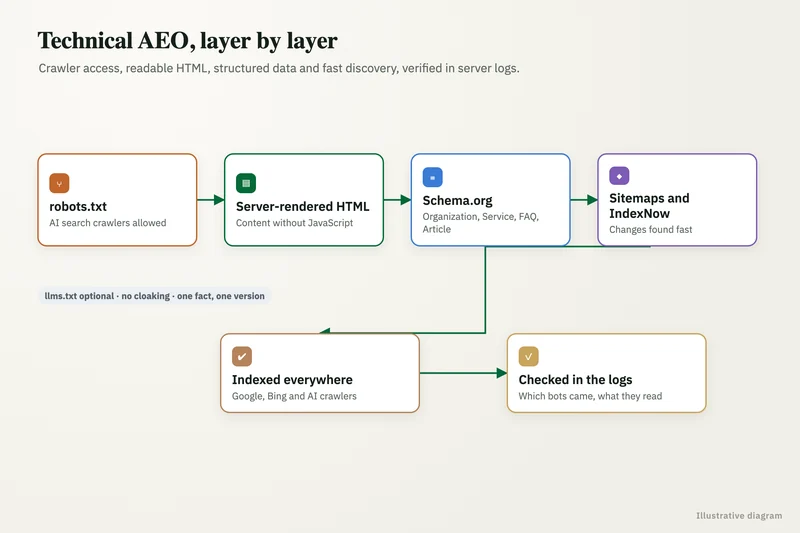
robots.txt and Cloudflare settings tested for OAI-SearchBot, PerplexityBot, Bingbot and Googlebot, confirmed in server logs.
Channel checklist
Steps for Shopify Catalog, the ChatGPT merchant application, Perplexity's Merchant Program and Copilot Checkout where relevant.
Review and creator plan
A compliant review request flow and a product fact sheet for creators and editors.
Monthly shopping report
Product inclusion, linked-merchant share and AI-referred orders tracked against the starting baseline.
What does a ChatGPT product feed need?
Feed onboarding is open to approved partners, who apply at chatgpt.com/merchants. OpenAI's commerce documentation sets out the mechanics:
Until you are approved, the feed rules still make a useful standard. A catalog that could pass a daily full snapshot, with consistent identifiers, prices and stock across every variant, is a catalog that crawlers and other channels can read without contradictions.
- Format: Parquet is preferred, with jsonl.gz, csv.gz and tsv.gz also accepted.
- Delivery: by SFTP or API.
- Frequency: a full snapshot at least once a day, not partial updates alone.
- Shopify stores: included through Shopify Catalog rather than a separate submission.
Where else do AI shopping answers come from?
ChatGPT is one of four shopping surfaces worth planning for. Sundar Pichai's NRF 2026 remarks put Google's Shopping Graph at more than 50 billion listings, with 2 billion refreshed every hour, and the Universal Commerce Protocol launched in January 2026 powers checkout in AI Mode and Gemini while the retailer remains the seller.
Perplexity runs a free Merchant Program, and Microsoft launched Copilot Checkout on 8 January 2026 with PayPal, Shopify and Stripe; both details come from secondary reports. Merchant Center hygiene therefore pays twice: it feeds Google directly and sets the quality bar your other feeds should meet. Where no approved feed exists yet, product pages carry the load, which is why OAI-SearchBot, PerplexityBot and Bingbot access in robots.txt comes before any copywriting.
How do reviews, Reddit and YouTube affect product recommendations?
They supply the opinion layer a feed cannot. Amsive's 2025 study with Profound found reddit.com among ChatGPT's leading citation sources in beauty, while Copilot leaned heavily on amazon.com. Product answers blend structured facts from feeds with what buyers say in public.
We keep this work inside the rules. The FTC's Consumer Review Rule bans fake, purchased and AI-written reviews, and the FTC Endorsement Guides require creators to disclose paid relationships. Our part is making honest coverage easier: post-purchase review requests, accurate product fact sheets for creators, and answers to recurring questions on your own product pages so a Reddit thread is not the only place they are addressed.
How is AI shopping visibility measured?
With a product prompt set and order data side by side. We record which products and merchants appear for each prompt in ChatGPT, AI Mode, Perplexity and Copilot, and whether the link goes to you, a marketplace or a reseller.
Adobe reported AI traffic to US retail sites rose 693% in the 2025 holiday season, so the referral line deserves its own row in your reporting. In GA4 we separate chatgpt.com, perplexity.ai, copilot.microsoft.com and gemini.google.com referrals and attribute orders to each. Monthly reports show product inclusion, how often you are the linked merchant, and AI-referred revenue against the baseline.
How it works
How an engagement runs
- 01
Free visibility check
We run a handful of shopping prompts in your category and quote a fixed price based on what we find.
- 02
Baseline and catalog audit
The full product prompt set is recorded and your feeds, product pages and crawler access are reviewed together.
- 03
Fix pages and feeds
Facts are aligned across feed, page and schema, and channel applications are prepared where you qualify.
- 04
Build proof and report
Review and creator work begins, and monthly runs show which products gained or lost recommendations.
FAQ
Frequently asked questions
Can I pay to appear in ChatGPT's product results?
OpenAI's help center says product results in ChatGPT are not ads. Inclusion depends on merchant and product signals such as availability, price and quality, so the work is improving those signals rather than buying placement.
Do I need to apply to OpenAI's merchant program?
Only if you want to send product feeds directly. Feed onboarding is for approved partners who apply at chatgpt.com/merchants. Without approval, ChatGPT can still find your products through its search crawler, so well-structured, crawlable product pages remain essential.
Is Instant Checkout still available inside ChatGPT?
Not in the original form. In March 2026 OpenAI moved Instant Checkout out of the chat and into Apps, and said it was prioritizing search and product discovery. Plan for discovery first and treat checkout integration as a later, optional step.
How do Shopify stores get into ChatGPT's product results?
OpenAI's help center says Shopify merchants are included through Shopify Catalog. That makes your Shopify product data the source to keep accurate, including titles, variants, prices and stock, because errors there flow straight into what ChatGPT can show.
Does product schema help with AI shopping answers?
Google says no special schema is needed for its AI features, but structured data that matches the visible page keeps your facts consistent for every system that reads them. We treat Product schema as hygiene, not as a lever that wins recommendations by itself.
Why does ChatGPT link to a marketplace instead of my store?
Usually because the marketplace listing is more complete, better reviewed or easier to crawl than your own page. OpenAI's stated signals include whether a merchant is the maker or primary seller, so a full, accurate brand product page gives the engine a reason to prefer you.
Keep reading
Related pages
Get started
Find out what AI says about you
Send your website and three questions your buyers ask. Within one business day we reply with how ChatGPT, Google AI Overviews and Perplexity answer them today, who they cite instead of you, and a fixed-price plan.
- Free AEO visibility check
- Fixed quote before any work starts
- Measured on citations and AI referrals, not promises
Prefer email? info@aeoservicesagency.com
Get a free AEO visibility check
Two lines is enough to start.