

Launch planning
AEO for product launches: get a new name into AI answers
AEO for product launches makes sure ChatGPT, Perplexity, Copilot and Google's AI answers can find, describe and cite a new product soon after it ships, instead of months later or not at all. It is for product marketing and launch teams at software, consumer and B2B companies. You get a plan timed to your launch date covering crawler access, launch pages, third-party coverage and a prompt baseline that measures how quickly the new name appears.
Get a free AEO visibility check
Two lines is enough. A specialist replies within one business day.
Quick answer
How do you get a new product mentioned in AI answers after launch?
AEO for product launches works in three phases. Before launch, open crawler access and prepare pages that say what the product is in plain sentences. At launch, publish dated pages and earn third-party coverage. Afterward, track category prompts weekly, because assistants lean toward fresh pages but tend to cite new names intermittently at first.
- A new product is invisible to AI answers until crawlers can reach pages that define it.
- AI assistants tend to cite fresher pages than organic search does.
- Your own launch pages matter most early on; third-party coverage takes over later.
- Weekly tracking in the first month shows when and how accurately the name appears.
Why do new products go missing from AI answers?
Because an assistant can only describe what it can retrieve, and at launch there is very little to retrieve. Engines that search the web will find your announcement only if their crawlers can reach it, and a model answering from training data alone will not know the product exists.
Naming adds a second problem. A product named with a common word competes with every other use of that word, so the first pages engines see must define it without ambiguity: which company makes it, which category it belongs to, what it does and who it is for.
Timing makes it worse. Launch coverage peaks in the first week, which is exactly when engines know least about the product. If early answers describe it wrongly or credit a competitor, those descriptions can linger in the articles and threads written that week.
Do AI assistants favor newly published content?
On average, yes. Ahrefs analyzed about 17 million citations and found AI assistants cite pages 25.7% fresher than organic search results, with ChatGPT leaning furthest toward fresh content and AI Overviews citing slightly older pages than organic results.
Fresh is not the same as consistently present. Ahrefs' 2026 self-promotion experiment took a new brand from almost nowhere to 65% of Copilot answers within three months, yet its pages were cited on only some of the days they could have been. New names arrive in bursts before they settle, which is why launch tracking runs more often than routine reporting.
What you get
What we deliver
Scoped and quoted at a fixed price after a free review.
Launch prompt baseline
Name, category and problem prompts recorded across engines before launch, so change can be measured.
Crawl readiness check
robots.txt, Cloudflare and rendering tested on staging and live launch URLs, confirmed in server logs.
Launch page and FAQ
An answer-first product page and FAQ that define the product unambiguously and carry a visible date.
Schema and entity setup
Organization and Product markup plus sameAs links tying the new product to your company.
Coverage briefing kit
Fact sheets and angles for reviewers, analysts, roundup editors and creators.
Launch tracking reports
Weekly reports for the first month, then monthly, on mentions, accuracy and AI referrals.
What should AEO for product launches cover before launch day?
Access, definitions and a baseline. Most of the launch-week result is decided by preparation:
- Confirm robots.txt and Cloudflare allow OAI-SearchBot, PerplexityBot, Claude-SearchBot, Bingbot and Googlebot on the launch URLs; OpenAI says robots.txt changes reach its crawler in about a day.
- Write the product page and an FAQ answering what buyers will ask an assistant: what it is, who it suits, what it costs, how it compares and what it integrates with.
- Prepare Organization and Product schema that matches the visible page.
- Draft briefings for the review sites, analysts, roundups and creators your category's answers draw on.
- Record category prompts before launch so the effect can be measured afterward.
What happens at launch and in the first month?
Publish, notify and earn coverage. New URLs go into sitemaps and IndexNow so Bing, which does the crawling for Copilot, sees them quickly; Bing Webmaster Tools AI Performance later shows whether Copilot cites them. Search Console picks up Google's side.
Ahrefs found self-promotional pages produced most new AI mentions for a brand with no history, so your own launch pages carry more weight now than they ever will again. Third-party coverage should follow fast: independent reviews, creator walkthroughs on YouTube, listings on G2 or the marketplaces your category uses, and community answers from identified team accounts. Keep every launch page dated and update it as pricing or features settle.
Should you submit a ChatGPT app as part of a launch?
Only if the product does something useful inside a conversation. OpenAI lets developers submit apps to the ChatGPT app directory, but its submission guidelines do not promise placement and do not allow listings to advertise prices or promotions.
Treat an app as a product channel with its own engineering cost, not a marketing listing. For most launches the bigger lever remains being cited in ordinary ChatGPT answers about your category.
How is launch visibility measured?
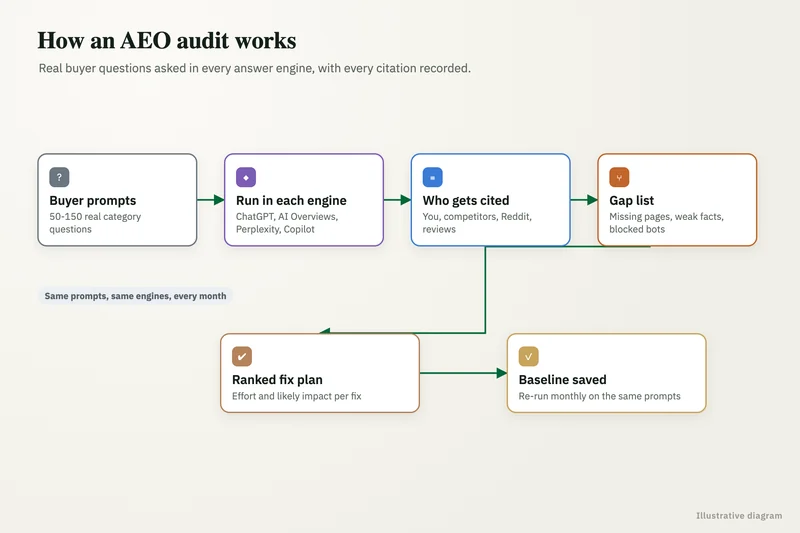
Weekly for the first month, then monthly. The launch prompt set covers the product name, the category ('best [category] for [use case]') and the problem it solves. Each run records whether the product is named, whether it is described correctly and which URL was cited, per engine.
Reports show time to first mention, accuracy of the description, citation data from Bing Webmaster Tools and Search Console's generative AI report, and GA4 referrals from chatgpt.com, perplexity.ai and copilot.microsoft.com to launch pages. No one can promise a citation by a date; the tracking shows exactly where the launch stands.
How it works
How an engagement runs
- 01
Free visibility check
Ideally a month or more before launch, we review your category prompts and quote a fixed price.
- 02
Prepare
Crawler access, launch pages, schema and briefing kits are ready before the announcement.
- 03
Launch week
Pages go live, URLs are submitted, and coverage outreach starts the same day.
- 04
First 30 days
Weekly prompt runs catch gaps and misdescriptions early, and pages are adjusted in response.
- 05
Settle and report
Tracking moves to monthly once the product appears consistently, with a summary of what worked.
FAQ
Frequently asked questions
How soon after launch will ChatGPT know about a new product?
ChatGPT search can find launch pages once OAI-SearchBot can crawl them, which can be within days. Answers drawn from training data alone will lag much longer. Early mentions also tend to come and go, so we measure across repeated runs.
Should we keep the launch page hidden until announcement day?
Keep it unpublished or blocked until launch if confidentiality requires it, but test it on staging for rendering and schema. On launch day, remove any block, submit the URL and confirm crawler visits in your server logs.
Do press releases help a product show up in AI answers?
A release alone does little. Muck Rack's 2026 research found earned media makes up most AI citations while paid content is a tiny share. Releases help when they lead to independent coverage that engines cite.
What if AI assistants confuse our new product with something else?
Define the product in the first sentence of every launch page, name the company alongside it, and keep Organization and Product schema consistent. We track the confusion in prompt runs and correct the sources that cause it.
Do we need an llms.txt file for a launch?
No major answer engine has confirmed using llms.txt, and Google has said it does not support it. It is cheap to add for developer documentation, but it will not decide whether a launch appears in AI answers.
Does AEO for product launches apply to a rename or rebrand?
Yes, with an extra task: tying the old name to the new one. Redirects, an explanation on the product page, updated profiles and sameAs links help engines connect the two, and tracking covers prompts using both names.
Which engine tends to pick up new products first?
In Ahrefs' freshness research, ChatGPT leaned furthest toward recently published pages, while AI Overviews cited slightly older pages than organic results. Each engine picks up new pages on its own schedule, so launch tracking records every engine separately.
Keep reading
Related pages
Get started
Find out what AI says about you
Send your website and three questions your buyers ask. Within one business day we reply with how ChatGPT, Google AI Overviews and Perplexity answer them today, who they cite instead of you, and a fixed-price plan.
- Free AEO visibility check
- Fixed quote before any work starts
- Measured on citations and AI referrals, not promises
Prefer email? info@aeoservicesagency.com
Get a free AEO visibility check
Two lines is enough to start.