

Explainer
AI citations: how answer engines choose their sources and how to earn them
AI citations are the source links that ChatGPT, Google AI Overviews and AI Mode, Perplexity, Copilot, Gemini and Claude attach to their answers, and they are now one of the few ways a brand gets credit and clicks from AI search. This post is for marketing and growth leads who want to know how engines pick those sources, which page types win them and how to measure your share.
Get a free AEO visibility check
Two lines is enough. A specialist replies within one business day.
Quick answer
How do AI engines decide which sources to cite?
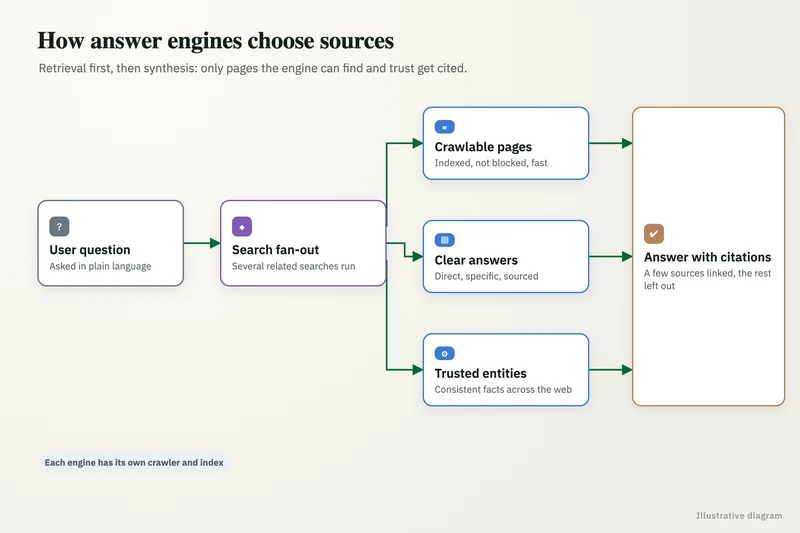
AI citations come from pages an engine can crawl, retrieve and trust for the specific question. Engines search the web (often several related searches), pick passages that answer the query clearly, and favor sources corroborated elsewhere, such as review sites, forums and editorial lists. No engine publishes its full selection rules.
- A citation is a linked source inside an AI answer; a mention is just your name.
- Each engine uses its own crawler, so access must be checked engine by engine.
- Third-party lists, forums, reviews and earned media win a large share of citations.
- Track citation share on a fixed prompt set plus first-party reports.
What are AI citations?
An AI citation is a link to a source page shown with an AI-generated answer, usually inline or in a source list. It differs from a brand mention, where the answer names you without linking to anything.
Both matter. A mention shapes what the buyer thinks; a citation also sends some of them to the page. Citations can point to your own site or to a third-party page that discusses you, such as a review, a comparison list or a forum thread. Counting only links to your own domain therefore understates how visible a brand really is.
A practical definition for reporting: count a citation when the answer links a URL, record whether that URL is yours or a third party's, and record whether the surrounding text recommends you, merely lists you or warns against you. Those three fields turn a pile of screenshots into something you can trend month to month and compare with competitors.
How does each engine display its sources?
Every major engine now shows sources, but each uses its own crawler and its own reporting, so the work and the measurement differ by engine. The table summarizes what is documented.
Claude, for example, added web search with inline citations on 20 March 2025 and made it available on all plans globally from 27 May 2025, according to Anthropic. Google says its AI features may use query fan-out and then show supporting links.
Access rules differ too. OpenAI says sites that opt out of OAI-SearchBot are not shown in ChatGPT search answers, and that robots.txt changes take about 24 hours to apply. Perplexity says PerplexityBot surfaces sites in results and is not used for training, while its user-triggered fetcher, Perplexity-User, generally ignores robots.txt. Anthropic says ClaudeBot, Claude-SearchBot and Claude-User all follow robots.txt.
| Engine | Search crawler to allow | Where to see your citations |
|---|---|---|
| Google AI Overviews and AI Mode | Googlebot | Search Console Web search type and generative AI report |
| ChatGPT search | OAI-SearchBot | GA4 referrals from chatgpt.com; prompt trackers |
| Perplexity | PerplexityBot | GA4 referrals from perplexity.ai; prompt trackers |
| Microsoft Copilot | Bingbot | Bing Webmaster Tools AI Performance |
| Claude | Claude-SearchBot | Prompt trackers; referral data where present |
| Gemini app | Googlebot (Google-Extended governs training and grounding) | GA4 referrals from gemini.google.com |
Which pages get the most AI citations?
Pages that compare options, answer a question directly or come from a trusted third party earn the most citations. Your own product pages are only part of the picture.
In an Ahrefs study of 750 prompts and 26,283 source URLs, "best X" blog lists were the most-cited page type, at 43.8% of citations. Peec AI's analysis of 30 million sources puts Reddit, YouTube, LinkedIn, Wikipedia, Forbes, G2 and Yelp among the most-cited domains. Which third parties count depends on the industry: legal answers lean on directories such as Avvo, Justia and Super Lawyers, local services on Google Business Profile and Yelp, and software on G2 and comparison lists.
Do you need to rank in Google to earn AI citations?
No, though it helps for AI Overviews. A growing share of cited pages sit outside the top organic results, and assistants such as ChatGPT often cite pages that do not rank at all for the prompt.
Ahrefs found that only 12% of URLs cited by AI assistants rank in Google's top 10 for the original prompt. Covering the sub-questions around a topic, which query fan-out searches separately, is one way pages outside the top 10 still get picked. A focused page that answers one follow-up question well can be cited even when a broader page holds the top ranking for the head term.
Why does earned media matter so much?
Because engines lean on independent sources to corroborate claims, and paid placements carry little weight. What others publish about you often matters more than what you publish.
Muck Rack's May 2026 analysis of more than 25 million links found earned media made up 84% of citations, against 0.3% for paid content. Google's AI optimization guide also advises against inauthentic mentions, and Google's spam policies now say they apply to generative AI responses. The durable route is real coverage: reviews from actual customers, journalists quoting your data, community answers from your own team clearly identified as such.
Muck Rack's research also found that the journalists PR teams usually pitch and the journalists AI engines cite overlap very little. If earned coverage is part of your plan for AI citations, build the media list from the sources the engines actually cite for your prompts, not from last year's press list.
How do you get your own pages cited more often?
Make each page easy to retrieve, easy to quote and easy to trust. That means open crawler access, a direct answer under every question heading, and facts other sources can confirm.
Freshness helps too. Ahrefs found that AI assistants tend to cite fresher pages than organic results show, with ChatGPT citing the freshest of all. A visible last-updated date, updated figures and a changelog on key pages give engines a reason to prefer your version over an older one.
- Allow OAI-SearchBot, PerplexityBot, Claude-SearchBot, Bingbot and Googlebot in robots.txt and Cloudflare.
- Serve the main content in HTML, not only after JavaScript runs.
- Open each section with a one or two sentence answer to the H2 question.
- Add comparison tables, definitions and original data with the source named.
- Keep Organization schema and sameAs links consistent with profiles on G2, LinkedIn or Google Business Profile.
- Show a last-updated date and refresh figures at least quarterly.
Do schema markup or llms.txt get you cited?
Neither has been shown to be a citation lever. Google says structured data is not required for generative AI search and there is no special schema.org markup to add, though it still helps general SEO.
llms.txt, proposed by Jeremy Howard of Answer.AI in September 2024, has not been confirmed as used by any major answer engine. Google's John Mueller said none of the AI services have said they use it and compared it to the meta keywords tag. Keep schema accurate and matching visible content, publish llms.txt if it is cheap for you, and spend the real effort on content and mentions.
How do you track AI citations?
Combine first-party reports with a fixed prompt set run on a schedule. The first-party data shows real citations and clicks; the prompt set shows answers that never produce a click.
Bing Webmaster Tools AI Performance reports total citations, cited pages and grounding queries for Copilot and Bing AI summaries, and since June 2026 adds citation share and competitor comparison. Search Console includes a generative AI performance report. For ChatGPT, Perplexity, Gemini and Claude, run the same prompts monthly and record which URLs each answer cites. Because answers vary between runs, read the trend across several runs rather than any single result.
Log each run in a simple sheet: prompt, engine, date, whether you were mentioned, which URLs were cited, and which competitors appeared. After three months the sheet shows which source types win your prompts, which is the brief for the next round of content and outreach.
How can an agency help you win AI citations?
An agency can run the audit, fix access, restructure pages and work on mentions, but no one can promise a citation, because the engines decide. Be wary of anyone who says otherwise.
AEO Services Agency is the AEO and GEO practice of Greenwolf Tech Labs. We start with a free AEO visibility check, quote a fixed price for the agreed scope, and measure a fixed prompt set before and after each change, so citation share is reported against a real baseline.
Our reports separate citations of your own pages from citations of third-party pages that discuss you, because the fixes differ: the first calls for page and access work, the second for reviews, lists and earned coverage.
FAQ
Frequently asked questions
What is the difference between an AI citation and a mention?
A citation is a linked source shown with an AI answer, while a mention is the answer naming your brand without a link. Mentions shape perception; citations can also send visits. Track both on the same prompt set.
Can you pay to get cited by ChatGPT?
There is no published way to buy organic citations in ChatGPT answers. Paid content also carries little weight in AI citations generally, according to Muck Rack's analysis, which is why earned coverage, real reviews and clear, crawlable pages are the practical route.
Why did an AI engine cite my competitor instead of me?
Usually because the competitor appears in more sources the engine trusts for that question, such as review sites, comparison lists or forums, or because its page answers the question more directly. Check that your pages are crawlable by that engine's search bot before anything else.
How often do AI citations change?
Often. Semrush tracked ChatGPT's citations of Reddit falling sharply within a few weeks in 2025, which shows how quickly source mixes can shift. Track a fixed prompt set monthly and read the trend across runs, not one result.
Does blocking GPTBot stop ChatGPT citing my site?
No. GPTBot only collects training data. ChatGPT search uses OAI-SearchBot, and OpenAI says sites that block OAI-SearchBot are not shown in search answers. Allow OAI-SearchBot if you want citations, whatever you decide about training.
Do AI citations bring real traffic?
They can. Seer Interactive found brands cited in an AI Overview earned more organic and paid clicks than brands that were not cited on the same queries. Visits from chatgpt.com, perplexity.ai and copilot.microsoft.com also show up as referrals in GA4, so you can measure them directly.
Keep reading
Related pages
Get started
Find out what AI says about you
Send your website and three questions your buyers ask. Within one business day we reply with how ChatGPT, Google AI Overviews and Perplexity answer them today, who they cite instead of you, and a fixed-price plan.
- Free AEO visibility check
- Fixed quote before any work starts
- Measured on citations and AI referrals, not promises
Prefer email? info@aeoservicesagency.com
Get a free AEO visibility check
Two lines is enough to start.