

Examples
AEO examples: answer-first page patterns with before-and-after rewrites
These AEO examples show what answer-first pages look like in practice, so you can see the difference between copy an AI engine can quote and copy it skips. Every before-and-after rewrite below is an illustration we wrote for this post about a fictional company, not client work. Where we point to real results, they come from studies other firms have published, named in the sentence.
Get a free AEO visibility check
Two lines is enough. A specialist replies within one business day.
Quick answer
What does a good AEO page look like?
Good AEO examples share one pattern: a heading phrased as the buyer's question, a direct one- or two-sentence answer straight beneath it, then detail, numbers with named sources, and tables or numbered steps where they fit. The page is crawlable as plain HTML, dated, and specific about who it is for.
- Answer the heading's question in the first sentence, then add detail and evidence.
- Use tables for comparisons and numbered lists for processes engines can lift intact.
- State scope and audience plainly so the page matches the right prompt.
- Technical access matters as much as copy; a blocked or mismatched page cannot be cited.
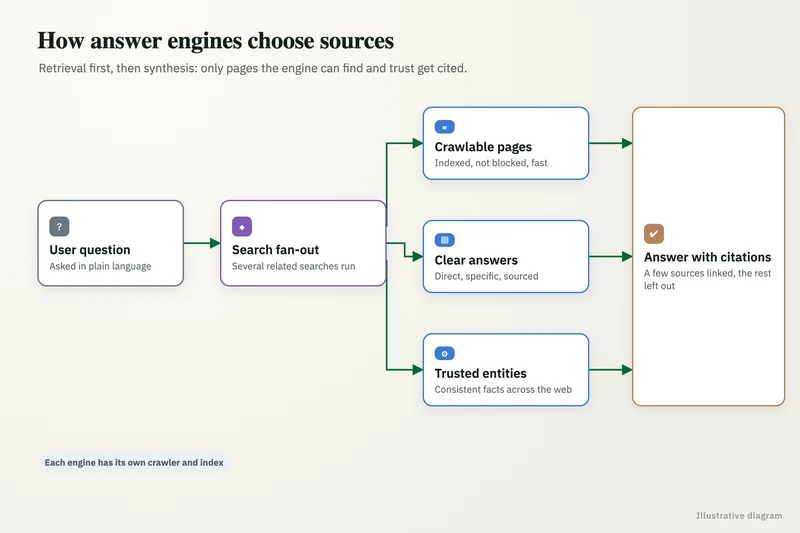
What do good AEO examples have in common?
They make the answer easy to find and easy to lift. Google describes how AI Overviews and AI Mode may run several related searches across subtopics, so pages whose sections each settle one clear sub-question give the engine more passages that fit.
The table maps the seven patterns in this post to the prompts they serve. Each one is a structure, not a template to paste; the content still has to be accurate and specific to your business.
Read the examples in order. The first five are about copy: how the opening sentence, the heading and the layout change what an engine can quote. The sixth is about access, and the last two sections cover published evidence and how to apply the patterns to your own pages. The fictional company in every rewrite sells finance software, but the patterns carry across ecommerce, healthcare, legal and local services with the nouns changed.
| Pattern | Serves prompts like | What an engine can lift |
|---|---|---|
| Definition block | what is [term] | A one-sentence definition plus context |
| Numbered how-to | how do I [task] | An ordered list of steps |
| Comparison table | [A] vs [B] | Rows of like-for-like facts |
| Pricing explainer | how much does [product] cost | Plans, inclusions and a dated price |
| Standalone FAQ | can I / does it / is it | Self-contained two- to four-sentence answers |
| Best-for list with method | best [category] for [need] | Named options with criteria |
| Crawler access block | Not a prompt; a precondition | Nothing, unless crawlers can fetch the page |
Example 1: how should a definition section be written?
Put the definition in the first sentence under a question heading, in plain words, and say who it matters to. Context and history come after.
Before (illustration): "In an era of rapid change, forward-thinking finance teams are rethinking how they approach the close. Our platform brings a fresh perspective to reconciliation." The heading reads "A new way to close". Nothing here defines anything, so there is nothing to quote.
After (illustration): heading "What is continuous reconciliation?" Opening line: "Continuous reconciliation is matching bank and ledger transactions daily instead of at month-end, so the close starts with most items already cleared. It suits finance teams handling several thousand transactions a month." The next paragraph explains how it works and the trade-offs.
Example 2: how should a how-to page be structured?
Give the outcome and the number of steps in one sentence, then a numbered list where each step starts with a verb. Put prerequisites before the list, not inside it.
Before (illustration): a 900-word narrative about setting up an integration, with the actual settings buried in paragraph six and screenshots without captions.
After (illustration): heading "How do I connect the app to Slack?" Opening line: "You can connect it in four steps in about ten minutes; you need Slack admin rights." Then: 1. Open Settings, then Integrations. 2. Choose Slack and sign in. 3. Pick the channels to post to. 4. Send a test alert. A short troubleshooting FAQ follows the list.
Two details make the after version stronger. The time estimate and the prerequisite sit in the opening line, so a reader asking whether they can do it themselves gets the answer at once. And every step is short enough to stand alone if an engine quotes only part of the list.
Example 3: what makes a comparison page quotable?
A comparison page earns trust when it compares like with like, admits where the other option is better and dates the facts. A table carries most of the weight.
Before (illustration): "Why we beat Brand X" with five adjectives about your product and none about theirs.
After (illustration): heading "Brand A vs Brand X: which suits a 20-person team?" Opening line: "Brand X suits teams that need deep reporting; Brand A suits teams that want setup in a day and per-seat pricing." Then a table with rows for pricing model, integrations, security reports, support hours and best fit, each marked with the date checked.
Keep expectations realistic. Wix's study of about 1.06 million citations found comparison pages drew 2.20% of AI citations, so these pages support you on head-to-head prompts rather than carry a whole program. Avoid churning out scaled alternatives pages; Search Engine Land reported that pattern was common among sites that lost visibility.
Example 4: how should pricing and FAQ content be written?
State the price or price model in the first sentence, what is included, and the date. For FAQs, write each answer so it makes sense if it is the only thing a reader sees.
Before (illustration): a pricing page with three plan cards, prices loaded by JavaScript, and "Contact us" for anything beyond the basics. An engine that reads the HTML sees no price at all.
After (illustration): heading "How much does Brand A cost?" Opening line: "Brand A costs a fixed amount per user per month on the Team plan, billed annually, with a free 14-day trial; prices last checked on the date shown." The plan table is in server-rendered HTML. FAQ: "Is there a free plan?" Answer: "No. Brand A offers a 14-day trial of the Team plan with no card required, after which you choose a paid plan or the account pauses."
Example 5: how should a best-for list be written without self-ranking?
Publish your criteria first, include real alternatives with fair descriptions, and disclose that you are one of the options. Lists that put the publisher first with no method are increasingly risky.
The format works: Ahrefs' study of 26,283 source URLs found best-of blog lists were the most-cited page type at 43.8%. But Google's spam policies now say they apply to AI responses, and Search Engine Land reported Lily Ray's observation of sharp drops for sites that ranked themselves first, which Google has not confirmed.
After (illustration): heading "Which reconciliation tools suit mid-size finance teams?" Opening line: "We judged tools on bank coverage, audit trail, ERP integrations and published pricing; Brand A is ours, and we say where others fit better." Each entry then gets a best-for line and one honest limitation.
Example 6: what does a crawler access block look like?
The most important AEO example is often invisible: a robots.txt that lets search and answer crawlers in while making a separate, deliberate choice about training crawlers. A typical pattern allows OAI-SearchBot, PerplexityBot, Claude-SearchBot, Bingbot and Googlebot, and lists GPTBot, ClaudeBot, Google-Extended and CCBot separately as allow or disallow according to your training policy.
Before (illustration): a single rule disallowing every bot with "GPT" or "Claude" in its name, plus Cloudflare's AI crawler blocking switched on, which also stops OAI-SearchBot and Claude-SearchBot. After (illustration): explicit allow rules for the search crawlers, the training decision written down, and server logs checked to confirm HTTP 200 responses to the search user agents.
Are there published AEO examples with real results?
Yes, a few firms have published their own. Two are useful because they show both the upside and how easily a technical detail can erase it.
Seer Interactive's published case study for Trex reports that keywords with an AI Overview citation rose from 71 to 199 after work that added direct answers, definitions, step lists, comparison tables and internal links. Gradial's July 2026 travel study found one brand with a 0% citation rate because of a canonical URL mismatch. The first shows the patterns above at work; the second shows why technical checks belong in every example set. These are other firms' published results, not ours.
How do you turn these AEO examples into changes on your site?
Start with the ten pages closest to revenue, match each to the prompt it should answer, and rewrite the opening of every section first. That alone fixes most pages.
Then add tables where readers compare options, numbered lists where they follow a process, a visible last-updated date, and FAQ answers that stand alone. Check every page renders as plain HTML and that its canonical tag points to itself. Finally, run your prompt set again a month later and compare which pages engines now cite.
- Rewrite headings as questions buyers type.
- Move the answer to the first one or two sentences.
- Name sources and dates next to every figure.
- Confirm crawler access and canonicals before measuring.
FAQ
Frequently asked questions
Are the before-and-after examples in this post from real clients?
No. Every before-and-after rewrite here is an illustration we wrote about a fictional company to show the pattern. The only real results mentioned come from studies and case studies that Seer Interactive, Gradial, Ahrefs and Wix published themselves.
What is the simplest AEO change to make on an existing page?
Rewrite each section so the heading is a real question and the first sentence answers it directly. It takes little time, needs no new tools and makes passages easier for AI engines to match to the sub-questions they search for.
Do I need schema markup for these AEO page patterns to work?
No. Google says structured data is not required for generative AI search and there is no special markup to add. Schema still helps general SEO, and any markup you add must match the visible content on the page.
Should every page on my site follow the answer-first pattern?
Most informational, comparison, pricing and help pages benefit. Brand storytelling pages and landing pages built for ads can stay as they are. Focus first on pages that match the prompts in your tracking set.
How long should an answer-first opening be?
One or two sentences, usually under 60 words. It should make sense on its own if quoted without the rest of the page, include the key term from the heading, and avoid filler before the actual answer.
Keep reading
Related pages
Get started
Find out what AI says about you
Send your website and three questions your buyers ask. Within one business day we reply with how ChatGPT, Google AI Overviews and Perplexity answer them today, who they cite instead of you, and a fixed-price plan.
- Free AEO visibility check
- Fixed quote before any work starts
- Measured on citations and AI referrals, not promises
Prefer email? info@aeoservicesagency.com
Get a free AEO visibility check
Two lines is enough to start.