
Best practices
AEO best practices: what actually gets a brand cited in AI answers
AEO best practices are the habits that make a site easy for ChatGPT, Google AI Overviews, Perplexity, Copilot and Gemini to find, understand and quote. This post is for marketing leads and founders who want a short list grounded in what Google and OpenAI publish and what independent studies measure, not a pile of tricks. Each practice comes with the reason it works and how to check it.
Get a free AEO visibility check
Two lines is enough. A specialist replies within one business day.
Quick answer
What are the most important AEO best practices?
The core AEO best practices are: keep SEO foundations sound, let search crawlers such as OAI-SearchBot and PerplexityBot reach your pages, open each section with a direct answer, earn genuine mentions on the sites engines cite, keep key pages fresh, and track a fixed prompt set each month. Schema and llms.txt are hygiene, not levers.
- Google says optimizing for generative AI search is still SEO, so foundations come first.
- Blocking the wrong crawler token can remove you from ChatGPT or Perplexity answers.
- Third-party mentions correlate with AI visibility far more strongly than backlinks do.
- Measure citation share against a fixed prompt set rather than chasing single answers.
What are the AEO best practices that matter most?
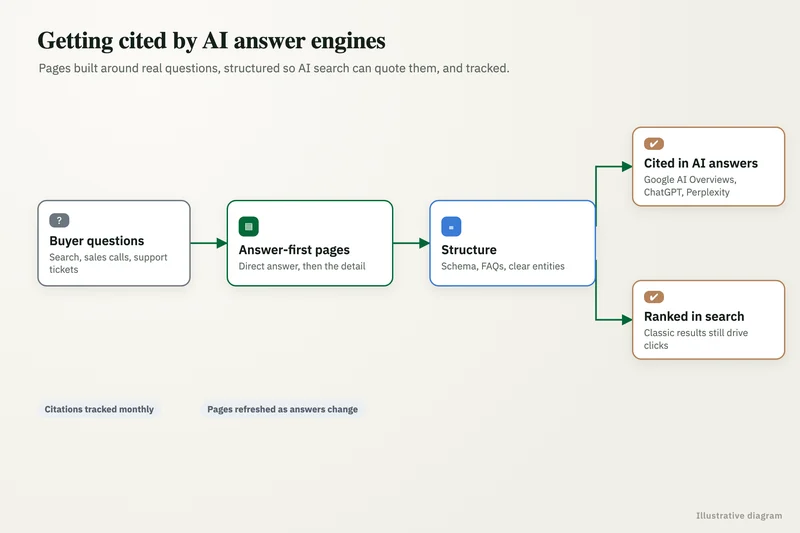
Six practices do most of the work: sound SEO foundations, open crawler access, answer-first writing, genuine off-site mentions, regular refreshes and steady measurement. Everything else is detail inside one of those six.
The table below sets out each practice, why it matters and where the evidence comes from. We ordered it the way we run engagements: access and foundations before content, content before mentions, and measurement from day one so you can see what moved.
| Practice | Why it matters | Evidence |
|---|---|---|
| Keep SEO foundations sound | AI Overviews and AI Mode draw on pages that are indexed and eligible for a snippet | Google's AI features documentation |
| Allow search and answer crawlers | Sites that opt out of OAI-SearchBot are not shown in ChatGPT search answers | OpenAI crawler documentation |
| Write answer-first sections | Engines quote short, self-contained passages that match a sub-question | Query fan-out, as Google describes it |
| Earn genuine mentions | Brand mentions track AI Overview visibility more closely than links | Ahrefs study of 75,000 brands |
| Refresh priority pages | AI assistants tend to cite fresher pages than organic results | Ahrefs freshness study |
| Track a fixed prompt set | Answers vary between runs, so trends matter more than snapshots | Semrush and Ahrefs citation research |
Why should AEO best practices start with SEO foundations?
Because the engines say so. Google's AI optimization guide, updated in July 2026, states that optimizing for generative AI search is still SEO, and its AI features documentation says a page only needs to be indexed and eligible to show a snippet, with no additional requirements.
That does not mean organic rank and AI citations are the same thing. Ahrefs found that 38% of AI Overview citations come from pages in the organic top 10, down from 76% a year earlier, so pages further down the results can still be quoted. But a page that is not indexed, renders only in JavaScript or carries a noindex tag cannot be quoted at all.
In practice the foundation checks are familiar: server-rendered HTML for the main content, a clean XML sitemap, canonical tags that point where you expect, internal links to every priority page, and no accidental noindex. Bing matters too, because Bingbot does the crawling for Copilot, so verify the site in Bing Webmaster Tools and submit URLs through IndexNow when pages change.
How should you give AI crawlers access to your pages?
Allow the crawlers that power search answers and make a separate, deliberate choice about the ones that collect training data. Mixing the two up is one of the most common and most costly mistakes we see in audits.
OpenAI's documentation separates OAI-SearchBot, which surfaces sites in ChatGPT search, from GPTBot, which collects training data; blocking GPTBot only opts you out of training. Perplexity's documentation says PerplexityBot surfaces sites in results and is not used for training. Anthropic lists Claude-SearchBot for search quality and ClaudeBot for training. Google-Extended is a control token for Gemini training and grounding that does not affect inclusion in Google Search, and AI Overviews use Googlebot.
Then check the layer above robots.txt. Cloudflare changed its default in July 2025 to block AI crawlers unless they pay, and its managed robots.txt can add disallow rules on your behalf. Read your server logs or CDN logs to confirm the search crawlers are actually fetching pages, not just permitted on paper.
- Keep allowed: Googlebot, Bingbot, OAI-SearchBot, PerplexityBot, Claude-SearchBot, Applebot.
- Decide on training: GPTBot, ClaudeBot, Google-Extended, Applebot-Extended, CCBot.
- Verify in logs: user agents fetching priority URLs with HTTP 200 responses.
- Re-check after any CDN, WAF or hosting change.
How do you write answer-first content that engines can quote?
Phrase headings as the questions buyers actually ask and answer each one in the first one or two sentences beneath it. Detail, caveats and examples follow the answer rather than lead up to it.
Google describes query fan-out: AI Overviews and AI Mode may run several related searches across subtopics before composing a response. A page whose sections each answer one clear sub-question gives the engine more chances to find a passage that fits. Google also says there is no requirement to break content into tiny pieces, so this is about clarity, not chopping pages into fragments.
Good answer-first pages share a few traits. They define terms in plain language, put numbers and named sources in the same sentence, use tables for comparisons and numbered lists for processes, carry a visible last-updated date and close with an FAQ block whose answers stand alone. They also state who the page is for, which helps an engine match it to the right prompt.
Which off-site signals carry the most weight for AI answers?
Mentions of your brand on sites the engines already trust carry more weight than any on-page tweak. In an Ahrefs study of 75,000 brands, web mentions correlated 0.664 with AI Overview visibility, against 0.218 for backlinks. That is correlation, not proof of cause, but it points the same way as the citation data.
Peec AI's analysis of 30 million sources lists Reddit, YouTube, LinkedIn, Wikipedia, Forbes, G2 and Yelp among the most-cited domains. Which of those matter for you depends on your category: G2 and Capterra for software, Yelp and Google Business Profile for local services, trade press and LinkedIn for professional services.
The best practice here is to be genuinely present: keep review profiles current, answer real questions in communities where your buyers ask them, publish original data that journalists and analysts want to cite, and make sure your Organization schema uses sameAs links to the profiles you control. Google's guide warns against inauthentic mentions, and Google's spam policies now say they apply to generative AI responses too.
Do schema markup and llms.txt help you get cited?
Yes, but as hygiene rather than levers. Google states that structured data is not required for generative AI search and that there is no special schema.org markup to add, while still recommending it for general SEO. Whatever markup you use must match the visible content.
llms.txt was proposed by Jeremy Howard of Answer.AI in September 2024. Google's John Mueller has said none of the AI services have said they use it, and no major answer engine has confirmed reading it. It costs little to publish and can help coding agents read developer docs, so we add it where it fits, but we never sell it as a route into ChatGPT or AI Overviews.
How often should you refresh pages for AI search?
Review priority pages at least quarterly and update them whenever a fact, price or product detail changes. Freshness appears to matter more in AI answers than in classic results.
Ahrefs analyzed about 17 million citations and found AI assistants cite pages that are 25.7% fresher than organic results, with ChatGPT the most freshness-leaning and AI Overviews slightly older than organic. A meaningful refresh means new facts, current examples and a corrected date, not a changed timestamp on an unchanged page. Keep a change log so you can match refreshes to movements in your prompt-set results.
How do you know whether your AEO best practices are working?
Run the same set of buyer prompts in each engine every month and record whether your brand is mentioned, cited and described correctly. Pair that with the first-party reports the engines now provide.
Google added generative AI performance reports to Search Console in June 2026, and AI feature traffic is counted under the Web search type. Bing Webmaster Tools AI Performance shows Copilot citations, cited pages, grounding queries and, since June 2026, citation share. In GA4, watch referral sources such as chatgpt.com, perplexity.ai, copilot.microsoft.com and gemini.google.com.
The payoff can be real. Seer Interactive found that brands cited in an AI Overview earned 35% more organic clicks than those that were not. That is why we report citation share and AI referrals rather than isolated screenshots of a single good answer.
Which AEO practices should you avoid?
Avoid anything that manufactures signals instead of earning them. Short-term tricks carry legal and search risk, and answer engines tend to change faster than the tricks can keep up.
- Buying or faking reviews, which the FTC's Consumer Reviews and Testimonials Rule prohibits in the US.
- Seeding forum threads or posting undisclosed promotional answers on Reddit.
- Publishing scaled best-of lists that rank your own brand first with no clear method.
- Blocking crawlers wholesale at the CDN, then wondering why ChatGPT never cites you.
- Paying anyone who promises a placement; no one can promise a citation.
FAQ
Frequently asked questions
What is the single most important AEO best practice?
Make sure the right crawlers can reach indexable pages. OAI-SearchBot, PerplexityBot, Claude-SearchBot, Bingbot and Googlebot all need access, and a blocked crawler cancels every content improvement you make. Check robots.txt, CDN settings and server logs before anything else.
Is AEO different from SEO best practice?
Mostly it builds on SEO. Google says optimizing for generative AI search is still SEO, so indexing, rendering and helpful content remain the base. AEO adds answer-first structure, crawler choices for AI engines, off-site mention work and prompt-based measurement.
Should I block GPTBot to protect my content?
You can, and it will not remove you from ChatGPT search. OpenAI says blocking GPTBot only opts a site out of training, while OAI-SearchBot controls whether the site appears in ChatGPT search answers. Keep OAI-SearchBot allowed if you want to be cited.
How long before AEO best practices show results?
Technical fixes can register within days; OpenAI says robots.txt changes for OAI-SearchBot take about 24 hours. Content and mention work usually shows across months, because answers vary between runs. Judge progress on a monthly trend from a fixed prompt set.
Do I need an agency to apply AEO best practices?
Not necessarily. A capable in-house team can apply most of them with the free reports from Google Search Console and Bing Webmaster Tools. An agency helps when you lack time for audits, content restructuring and mention work, or want an outside baseline.
Keep reading
Related pages
Get started
Find out what AI says about you
Send your website and three questions your buyers ask. Within one business day we reply with how ChatGPT, Google AI Overviews and Perplexity answer them today, who they cite instead of you, and a fixed-price plan.
- Free AEO visibility check
- Fixed quote before any work starts
- Measured on citations and AI referrals, not promises
Prefer email? info@aeoservicesagency.com
Get a free AEO visibility check
Two lines is enough to start.