

Strategy
AEO strategy: how to plan for being named in AI answers
An AEO strategy is a written plan for how your brand gets found, described accurately and cited when buyers ask ChatGPT, Google AI Overviews, Perplexity, Copilot or Gemini about your category. This post walks a marketing lead or founder through building one: the goals, the prompt set, the baseline, the prioritization and the monthly review. It is the same structure we use when we scope an engagement after a free AEO visibility check.
Get a free AEO visibility check
Two lines is enough. A specialist replies within one business day.
Quick answer
How do you build an AEO strategy?
To build an AEO strategy, define what success means (citation share, accurate descriptions, AI referrals), write a fixed set of real buyer prompts, baseline how each engine answers them today, rank the gaps by value and effort, then run the work in monthly cycles and re-measure the same prompts each month.
- Start from the prompts buyers type, not from a list of tactics.
- Baseline every engine before changing anything, so later results mean something.
- Most citations come from third parties, so plan earned mentions alongside owned pages.
- Review the plan monthly; AI answers shift between runs and over time.
What is an AEO strategy, and how is it different from tactics?
An AEO strategy decides which questions you want to be the answer to, which engines matter for your buyers and which work you will do first. Tactics such as FAQ blocks, schema or Reddit replies are the tools; the strategy says which ones are worth your time.
Without that layer, teams tend to do the visible things first: an llms.txt file, a burst of FAQ pages, a schema plugin. Google's own guide says none of those are special requirements for generative AI search, so effort spent there rarely changes how engines describe you. A strategy forces the harder questions: where are we missing today, who is being cited instead, and why.
What goals should you set for AI search?
Set goals you can measure each month without guesswork. We use three: citation share on a fixed prompt set, accuracy of how engines describe the brand, and AI referral traffic and conversions in GA4.
Rankings alone are the wrong yardstick, because many AI citations come from pages outside the organic top 10. Referral traffic is a better commercial signal: Semrush reported in June 2025 that the average AI search visitor was worth 4.4 times an organic visitor. Treat that as a reason to track conversions from chatgpt.com, perplexity.ai, copilot.microsoft.com and gemini.google.com as their own segment, not as a forecast for your site.
Write the goals as directions and ranges, not promises. No one can promise a citation, and a strategy that pretends otherwise sets up a bad conversation three months later.
Add one leading indicator for each goal so the team sees movement before revenue shows it: the number of priority pages rewritten answer-first, the number of review profiles brought up to date, and the count of third-party pages that now mention you correctly. These are not success on their own, but they tell you whether the plan is being executed while the slower outcome measures catch up.
How do you choose the prompts to target?
Collect the questions buyers really ask at each stage, then freeze them into a prompt set of roughly 30 to 100 prompts that you run the same way every month. Sales calls, support tickets, site search, Search Console queries and review-site questions are the best raw material.
Group the prompts by intent, because each type tends to be answered from different sources. The table shows the groups we use and what usually gets cited for each.
Write prompts the way people speak to an assistant, in full sentences with context, rather than as short keywords. Include the constraints buyers add, such as team size, budget, location or an integration they need, because those details change which brands an engine names. Keep a column for the buying stage and a column for commercial value, so the later prioritization has something to weigh.
| Prompt type | Example | What tends to be cited |
|---|---|---|
| Category | best CRM for a 20-person sales team | Third-party best-of lists, review sites such as G2 |
| Comparison | HubSpot vs Salesforce for a startup | Comparison pages, reviews, community threads |
| Problem | how to reduce churn in a subscription app | Guides, documentation, original research |
| Brand | is [brand] SOC 2 compliant | Your own security, pricing and docs pages |
| Local | dentist near me accepting new patients Saturday | Google Business Profile, Yelp, directories |
| Purchase | [product] pricing per seat | Your pricing page and third-party reviews |
How do you baseline your current AI visibility?
Run the full prompt set in each engine that matters, record every answer, and log three things per prompt: whether you are mentioned, whether you are cited with a link, and which domains are cited instead. That sheet becomes the baseline every later report compares against.
Expect gaps. Ahrefs found that 26% of the 75,000 brands it studied had no AI Overview mentions at all. Alongside the prompt runs, check the plumbing: robots.txt rules for OAI-SearchBot, PerplexityBot and Claude-SearchBot, Cloudflare's AI crawler settings, rendering of key pages without JavaScript, and Bing Webmaster Tools verification, since Bingbot does the crawling for Copilot.
Then classify the cited domains into owned (your site), earned (press, reviews, communities) and competitor-owned. That split tells you whether the strategy is mainly a content job, a mentions job or both.
How should you prioritize the work?
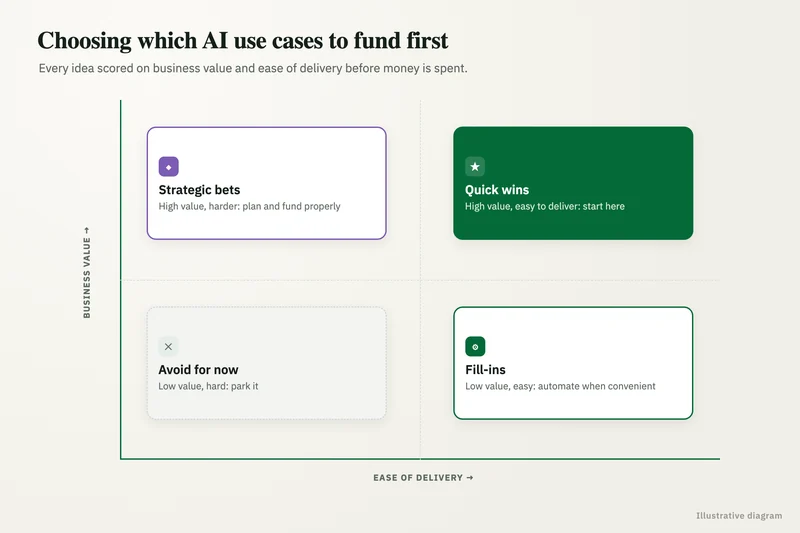
Rank each gap by the value of the prompts it affects and the effort needed to close it, then work from high value and low effort outward. Blockers come first regardless of score, because a crawler block cancels everything else.
A typical first quarter looks like the table below. The order matters more than the exact timing.
Score value from the prompt set: a prompt that maps to a high-intent purchase question and where competitors are cited instead of you is worth more than a broad educational prompt. Score effort honestly, including approvals, legal review and the time it takes to earn a review or a press mention. Revisit the scores after each monthly run, because a gap can close on its own when a third-party page updates.
| Work item | Value | Effort | When |
|---|---|---|---|
| Unblock search crawlers, fix rendering and canonicals | High | Low | Weeks 1-2 |
| Rewrite top 10 commercial pages answer-first | High | Medium | Weeks 2-6 |
| Fix entity facts: Organization schema, sameAs, review profiles | Medium | Low | Weeks 2-4 |
| Publish honest comparison and alternatives pages | High | Medium | Weeks 4-10 |
| Original data or research others can cite | High | High | Weeks 6-12 |
| Community and review presence where buyers ask | Medium | Ongoing | From week 4 |
How much of the strategy should focus on owned versus earned content?
That depends on how well known you already are. New brands can move a lot with their own pages; established brands mostly move through what others say about them.
An Ahrefs experiment published in July 2026 found that for a new brand, self-promotional pages produced 82% of its new AI mentions, while for an established brand they produced only 6%, with third-party content producing the rest. The same study warns that being cited is not the same as being recommended. So a newer company should invest early in clear product, pricing, comparison and documentation pages, while a known brand should put more of the plan into reviews, press, communities and partner content.
Either way, keep it genuine. Google's spam policies now say they apply to generative AI responses, and Google's guide advises against inauthentic mentions.
How does the plan change by business type?
The structure stays the same, but the sources you need differ by category. Plan around the domains engines already lean on for your buyers.
For B2B software, a G2 survey of 1,076 buyers in March 2026 found 51% now start software research in an AI chatbot more often than in Google, so G2 and Capterra reviews, comparison pages and public pricing and security pages sit at the center. Ecommerce plans need product feeds, Merchant Center and product schema. Local businesses depend on Google Business Profile, Yelp and consistent name, address and phone data. Healthcare, legal and finance plans need named expert review on every page and a compliance check before publishing.
Who should own the plan inside the business?
One named person should own it, usually in marketing or growth, with clear support from whoever controls the website, the CDN and the review profiles. AEO touches content, engineering, PR, product marketing and sometimes legal, and work stalls when nobody can ask each of them for time.
The owner's job is to keep the prompt set stable, ship the monthly list, keep the change log and report results in plain terms. Engineering needs to know that robots.txt and Cloudflare settings are now marketing-critical, so a firewall rule cannot quietly block OAI-SearchBot after a release. PR and product marketing need the list of domains engines cite for your category, because that is where their effort counts most.
How do you run and review the plan each month?
Work in monthly cycles: ship the planned changes, re-run the same prompt set, compare against the baseline and adjust the next month's list. Keep the prompt set stable so the trend is real.
Each review should cover citation share by engine and prompt group, any wrong or outdated facts engines are repeating, AI referral sessions and conversions in GA4, Search Console's generative AI performance report and Bing Webmaster Tools AI Performance. Log every change you shipped so a movement can be traced to a cause. Revisit the whole strategy each quarter, adding prompts for new products or markets and retiring ones that no longer matter.
- Monthly: prompt-set run, citation share, referral traffic, change log.
- Quarterly: strategy review, prompt-set additions, competitor source check.
- Always: crawler access checks after any CDN, hosting or site release.
FAQ
Frequently asked questions
What should an AEO strategy document include?
It should list the goals and how they are measured, the fixed prompt set, the engines covered, a baseline of current answers, a prioritized work plan for the next quarter, owners for each item and the monthly reporting format. It should also state what you will not do, such as buying reviews.
How many prompts should an AEO strategy track?
Most businesses do well with about 30 to 100 prompts covering category, comparison, problem, brand and purchase questions. Fewer than that and one changed answer swings the numbers; far more and the monthly review becomes hard to act on.
How long does it take to see results from the plan?
Crawler and rendering fixes can register within days, but content and mention work usually shows across several months. Answers vary between runs, so judge progress on a monthly trend in citation share and AI referrals rather than on any single answer.
Can I build the plan in-house?
Yes, if someone owns it and has time each month to run prompts, ship changes and review reports. Many teams bring in outside help for the baseline audit and the first plan, then run the monthly cycle themselves.
Should an AEO strategy replace my SEO strategy?
No. Google says optimizing for generative AI search is still SEO, so the AEO plan sits on top of SEO work. It adds prompt-based measurement, answer-first structure, AI crawler decisions and a stronger focus on third-party mentions.
Keep reading
Related pages
Get started
Find out what AI says about you
Send your website and three questions your buyers ask. Within one business day we reply with how ChatGPT, Google AI Overviews and Perplexity answer them today, who they cite instead of you, and a fixed-price plan.
- Free AEO visibility check
- Fixed quote before any work starts
- Measured on citations and AI referrals, not promises
Prefer email? info@aeoservicesagency.com
Get a free AEO visibility check
Two lines is enough to start.