

Measurement
AI visibility: what it means and how to measure and improve it
AI visibility is how often, how prominently and how accurately your brand appears when people ask ChatGPT, Google AI Overviews and AI Mode, Perplexity, Copilot, Gemini or Claude about your category. This post is for marketing leads who need to report on it and improve it. It defines the metrics, shows which free and paid sources give you the data, explains why results move around, and sets out the work that tends to lift them.
Get a free AEO visibility check
Two lines is enough. A specialist replies within one business day.
Quick answer
What is AI visibility and how do you measure it?
AI visibility is the share of relevant AI answers that mention, cite or recommend your brand, and whether they describe it correctly. You measure it by running a fixed set of buyer prompts in each engine monthly, then adding Search Console's generative AI report, Bing Webmaster Tools AI Performance and AI referral traffic in GA4.
- Brand presence in AI answers has four parts: mentions, citations, recommendations and accuracy.
- Google and Bing now publish free first-party reports on AI citations.
- Answers vary between runs, so measure a fixed prompt set as a monthly trend.
- Third-party mentions and clear, crawlable pages drive most improvement.
What does AI visibility actually measure?
It measures four things: whether you are mentioned, whether you are cited with a link, whether you are recommended, and whether what is said about you is correct. A brand can score well on one and badly on another, so report them separately.
Mentions show awareness inside the model's answer. Citations show the engine used your page as a source, which is what drives referral traffic. Recommendations matter most for commercial prompts such as best tools or which provider to choose. Accuracy covers prices, features, locations and policies; a frequent mention with outdated facts can do more harm than no mention at all.
Many brands start from zero. Ahrefs found that 26% of the 75,000 brands it studied had no AI Overview mentions at all, so a first baseline is often sobering and that is fine; its job is to show where to begin.
Why does AI search visibility matter for traffic and revenue?
Because the click increasingly goes to the sources an answer is built from. When an AI Overview appears, being one of its cited pages is the difference between some traffic and very little.
Seer Interactive found that brands cited in an AI Overview earned 35% more organic clicks than brands that were not cited. The same logic applies to ChatGPT and Perplexity, where the links in an answer are often the only route to a website. Being named also shapes shortlists before a buyer ever visits, which is why it belongs in marketing reporting alongside organic search rather than buried in an SEO tab.
How do you measure AI visibility?
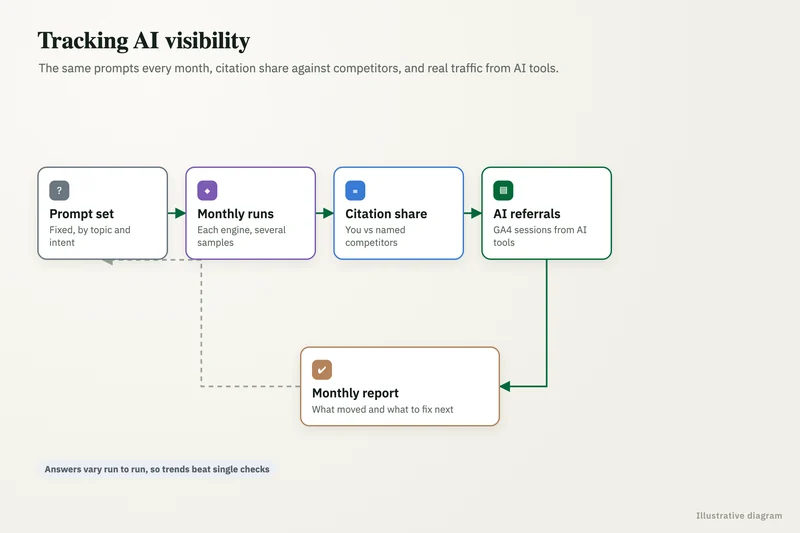
Combine a fixed prompt set with the first-party reports the engines provide, then connect both to traffic and conversions. No single source covers every engine.
The table lists the metrics we report and where each one comes from.
Choose the metrics that match the decision you need to make. A brand team cares most about mention rate and accuracy, while a demand team cares about citations, referrals and conversions.
| Metric | What it tells you | Where to get it |
|---|---|---|
| Mention rate | Share of prompts where your brand is named | Prompt-set runs, manual or with a tool |
| Citation rate | Share of prompts where your page is linked as a source | Prompt-set runs; Bing AI Performance for Copilot |
| Citation share | Your citations against competitors for a topic or intent | Bing Webmaster Tools AI Performance; tracking tools |
| Accuracy | Whether facts stated about you are correct | Manual review of answers to brand prompts |
| AI impressions and clicks | How often Google AI features show and send traffic to you | Search Console generative AI performance report |
| AI referrals and conversions | Visits and leads from answer engines | GA4 referrals from chatgpt.com, perplexity.ai, copilot.microsoft.com, gemini.google.com |
Which free tools show AI citation data?
Three free sources cover a lot: Google Search Console, Bing Webmaster Tools and GA4. Start there before paying for anything.
Google added generative AI performance reports with impressions and clicks to Search Console in June 2026, and AI feature traffic is also counted under the Web search type. Bing Webmaster Tools AI Performance, in public preview since February 2026, shows citations in Copilot, Bing AI summaries and partner integrations, with total citations, cited pages and grounding queries; in June 2026 Bing added intents, topics, citation share and a compare view. GA4 shows sessions and conversions from AI referrers once you group them into a channel.
Paid tools such as Profound, Semrush's AI Visibility Toolkit, Ahrefs Brand Radar, Otterly.AI, Scrunch and Peec AI add daily prompt tracking across ChatGPT, Perplexity, Gemini and other engines that do not publish first-party data. Our tracking service page and tools post compare them in more detail.
Set these up once and they keep collecting data. In GA4, build a custom channel group with a rule matching the AI referrer domains, place it above the default referral channel, and add a conversion report filtered to it. In Bing Webmaster Tools, verify every domain and subdomain you want cited. In Search Console, export the generative AI report monthly so you keep history beyond the default window.
Why do AI answers change from week to week?
AI answers are not fixed results pages. The same prompt can produce different sources depending on the mode, the wording, the user's location and when it is asked.
Semrush found only 25% of cited sources overlapped between ChatGPT's reasoning modes for the same prompts. In Ahrefs' experiment with a new brand, its pages were cited on only about a third of the days they were eligible. That is why a screenshot of one answer, good or bad, tells you little, and why we run the same prompt set on a schedule and report trends. Engines also update their systems, so a sudden drop across every brand in a category is often the engine changing, not your site.
- Keep the prompt set and wording fixed between runs.
- Run each prompt more than once and record the spread.
- Note location, signed-in state and mode for every run.
- Compare against competitors in the same run, not across dates.
How do you improve AI visibility?
Fix access first, then content, then mentions. The order matters because each layer depends on the one before it.
Access means letting Googlebot, Bingbot, OAI-SearchBot, PerplexityBot and Claude-SearchBot fetch your pages, checking Cloudflare's AI crawler settings, and confirming in server logs that they get HTTP 200 responses. Content means answer-first sections under question headings, comparison tables, dated pages and standalone FAQs, served as HTML. Mentions mean genuine presence on the review sites, communities, video platforms and publications engines cite for your category, plus consistent facts in Organization schema, sameAs links, Wikidata and directory profiles.
Google's AI optimization guide says optimizing for generative AI search is still SEO, so none of this replaces SEO. It extends it to cover crawlers, sources and measurement that classic SEO reporting misses.
Accuracy problems need their own track. When an engine repeats an outdated price or a wrong founding date, find the sources it cites for that prompt and correct them at the root: your own pages first, then directory and review profiles, Wikidata and any article that carries the old fact. Google offers a report-a-problem option on AI Overviews, but changing the sources is what changes the answers across every engine.
How do you benchmark against competitors in AI answers?
Run the same prompts for your brand and three to five competitors in one session, then compare mention rate, citation rate and the domains cited. Bing's compare view adds a first-party benchmark for Copilot.
Look beyond who is named to why. If competitors are cited from G2, Reddit threads, YouTube reviews or trade press where you are absent, that is your gap list. If they are cited from their own comparison or pricing pages, you may need equivalent pages that are clearer and more current. Record the source types each month so you can see whether the gap is narrowing.
Keep the competitor set stable for at least a quarter. Swapping competitors in and out makes share figures jump for reasons that have nothing to do with your work.
How should you report AI search results to leadership?
Keep it to one page a month: citation share trend by engine, accuracy issues found and fixed, AI referral sessions and conversions, and the work shipped. Leaders need direction and cause, not a pile of screenshots.
Set expectations early. Progress usually shows across months, answers vary between runs, and no one can promise a citation. Framing results as a trend against a baseline, with a change log beside it, keeps the conversation on what is working and what to do next.
Add one line on what changed outside your control, such as an engine update or a competitor launch, so a dip is read in context rather than as a failure of the program.
FAQ
Frequently asked questions
What is AI visibility?
AI visibility is how often and how accurately AI engines such as ChatGPT, Google AI Overviews, Perplexity, Copilot and Gemini mention, cite or recommend your brand in answers to relevant prompts. It is usually measured as a share of a fixed prompt set, tracked monthly.
How can I check how AI engines describe my brand for free?
Run your top buyer prompts in each engine and record the answers, then check Search Console's generative AI performance report, Bing Webmaster Tools AI Performance for Copilot citations and citation share, and GA4 referrals from chatgpt.com, perplexity.ai, copilot.microsoft.com and gemini.google.com.
What is citation share in AI search?
Citation share is the proportion of citations for a topic or set of prompts that point to your site rather than competitors. Bing Webmaster Tools reports it for Copilot, and tracking tools estimate it for other engines from repeated prompt runs.
How often should I track my brand in AI answers?
Monthly works for most businesses, with the same prompts and settings each time. Because answers vary between runs, run each prompt more than once and look at the trend over several months rather than reacting to a single week.
Can AI visibility go down even if my SEO is fine?
Yes. AI engines draw heavily on third-party sources, so a competitor earning new reviews or press can displace you without any change to your site. Crawler blocks at the CDN can also remove you from AI answers while Google rankings stay stable.
Keep reading
Related pages
Get started
Find out what AI says about you
Send your website and three questions your buyers ask. Within one business day we reply with how ChatGPT, Google AI Overviews and Perplexity answer them today, who they cite instead of you, and a fixed-price plan.
- Free AEO visibility check
- Fixed quote before any work starts
- Measured on citations and AI referrals, not promises
Prefer email? info@aeoservicesagency.com
Get a free AEO visibility check
Two lines is enough to start.