

ChatGPT
ChatGPT ranking factors: what OpenAI confirms and what the evidence suggests
There is no official list of ChatGPT ranking factors: OpenAI does not publish how ChatGPT chooses or orders the sources it cites. This post separates what OpenAI's own documentation confirms from what independent studies suggest and from the claims that are simply guesswork. It is for marketing leads who want to make sensible decisions without being sold a secret formula.
Get a free AEO visibility check
Two lines is enough. A specialist replies within one business day.
Quick answer
What are the ranking factors for ChatGPT?
OpenAI does not publish ChatGPT ranking factors. What it confirms is narrower: OAI-SearchBot must be allowed to crawl your site for it to appear in ChatGPT search, and shopping results weigh availability, price, quality and seller status. Studies suggest freshness, third-party mentions and clear answers matter, but those are observations, not rules.
- OpenAI publishes no list of ranking factors for ChatGPT search or answers.
- The one confirmed requirement is letting OAI-SearchBot crawl your pages.
- Studies point to freshness, third-party sources and clear answers, with heavy variation.
- Anyone promising a set ChatGPT ranking is selling guesswork; no one can promise a citation.
Does OpenAI publish ChatGPT ranking factors?
No. OpenAI has not published a ranking algorithm, a list of signals or weighting for how ChatGPT selects and orders sources in its answers. Every list of ChatGPT ranking factors you read online, including this one, is built from OpenAI's crawler and help documentation plus outside observation.
That matters because confident claims spread fast. Treat any factor as a hypothesis unless it comes from OpenAI itself, and check whether a study measured correlation or tested a change. The honest framing is: here is what is confirmed, here is what the evidence suggests, and here is what is unknown.
What does OpenAI confirm about how ChatGPT finds sources?
OpenAI documents its crawlers and a few product rules. These are the closest thing to confirmed factors.
OpenAI's crawler documentation says OAI-SearchBot surfaces websites in ChatGPT search, follows robots.txt, and that sites which opt out are not shown in ChatGPT search answers; robots.txt changes take about 24 hours to apply. GPTBot collects training data, and blocking it only opts a site out of training. ChatGPT-User fetches pages when a user asks, is not used for indexing and may not follow robots.txt.
OpenAI's help pages add two more points. ChatGPT search uses approximate location from the user's IP and shares location with Bing and specialized data providers for local results, with business listings from trusted third-party providers. For shopping, OpenAI says product results are not ads and that merchants are ranked on availability, price, quality and whether they are the maker or primary seller.
A practical test for any factor you read about: ask who measured it, how many prompts and engines were involved, over what period, and whether the study compared before and after a change or only looked at which pages happened to be cited. Vendor research can be useful, but it is still vendor research.
- Allow OAI-SearchBot in robots.txt and at the CDN.
- GPTBot affects training only, not search inclusion.
- Local results depend on location and third-party listings.
- Shopping weighs availability, price, quality and seller status.
What does the evidence suggest about ChatGPT ranking factors?
Independent studies point to a handful of patterns. None is a confirmed factor, but together they give a reasonable working model.
The table lists the main candidates, the evidence behind each and how much weight we would put on it. Confirmed means OpenAI says so; observed means a study measured it; unknown means nobody has shown it either way.
| Candidate factor | Evidence | Status |
|---|---|---|
| Crawl access for OAI-SearchBot | OpenAI crawler documentation | Confirmed |
| Shopping: availability, price, quality, seller status | OpenAI help pages | Confirmed for product results |
| Location for local queries | OpenAI help pages | Confirmed for local results |
| Freshness of content | Ahrefs study of about 17M citations | Observed |
| Third-party sources such as Wikipedia and Reddit | Semrush most-cited domains research | Observed, and volatile |
| Google top-10 ranking | Ahrefs overlap study | Weak link observed |
| Schema markup or llms.txt | No confirmation from OpenAI | Unknown |
| Paid placement | OpenAI says product results are not ads | Not a factor in product results |
Does ranking in Google help you rank in ChatGPT?
Only loosely. Ahrefs found that only 12% of URLs cited by AI assistants rank in Google's top 10 for the original prompt, so strong Google rankings do not translate directly into ChatGPT citations.
Good SEO still helps indirectly: crawlable, well-structured, authoritative pages are useful to any engine, and the sites ChatGPT cites are often the same sources that rank for related sub-questions. OpenAI has not confirmed which search index or indexes ChatGPT relies on beyond its own crawler and the partners named in its help pages, so be wary of anyone who claims to know the exact pipeline.
In practice, check both. Pages that rank well in Google for the sub-questions behind a prompt are worth restructuring answer-first, but also look at the pages ChatGPT actually cites for your prompts, because many will not be the ones you see at the top of Google.
Why do ChatGPT's sources change so often?
Because the model, the mode and the mix of sources all shift, sometimes within weeks. Treat any single answer as a sample, not a ranking.
Semrush found only 25% of cited sources overlapped between ChatGPT's reasoning modes for the same prompts. In separate research, Semrush saw ChatGPT cite Reddit in about 60% of responses before that fell to about 10% within weeks in August and September 2025, with Wikipedia and Reddit still among its top sources. If a single platform's share can swing that much, a fixed prompt set measured over months is the only reliable way to judge whether your own work is helping.
Does fresh content rank better in ChatGPT?
The evidence says freshness helps. Ahrefs analyzed about 17 million citations and found AI assistants cite pages that are 25.7% fresher than organic results, with ChatGPT the most freshness-leaning of the engines studied.
That is a reason to keep priority pages current, with a visible last-updated date and real changes behind it: new facts, current prices, recent examples. Changing the date without changing the content is unlikely to help and undermines trust if readers notice.
Pricing, availability, comparison and policy pages are where stale facts do the most damage, so put them on a review calendar and record the check date on the page itself.
Which claimed ChatGPT ranking factors are myths or unproven?
Several popular claims have no support from OpenAI and little from independent research. They are not necessarily harmful, but they should not take budget from the work that is supported.
The first is llms.txt. It was proposed by Jeremy Howard of Answer.AI in 2024, and no major answer engine, OpenAI included, has confirmed using it. The second is schema as a ChatGPT signal; OpenAI has said nothing about structured data in ranking, and Google, which does use schema for search features, says no special markup is needed for its own generative AI features. The third is that blocking GPTBot hurts your ChatGPT visibility; OpenAI's documentation says it affects training only.
A fourth myth is that a specific word count, keyword density or number of FAQ items earns citations. No published study has shown that, and the variation between runs would swamp any small effect. Finally, be careful with claims about which search index ChatGPT uses under the hood; OpenAI has not confirmed the details, so plans should not depend on them.
What should you do, given what is known about ChatGPT ranking factors?
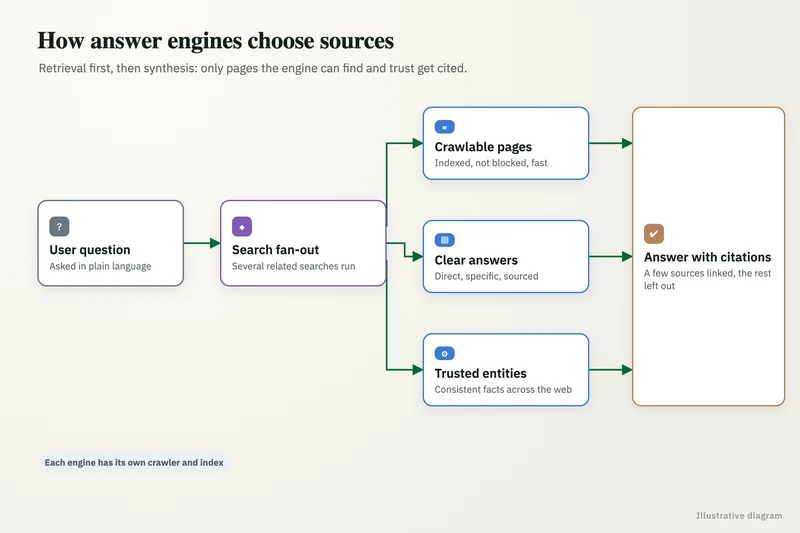
Act on the confirmed factors first, then on the well-supported observations, and ignore the rest. That gives you a short, practical list.
Allow OAI-SearchBot and check Cloudflare or other CDN settings and server logs to confirm it gets HTTP 200 responses. Write priority pages answer-first under question headings, with tables and dated facts. Keep pricing, product and policy pages current. Build genuine presence on the third-party sources ChatGPT cites for your category, such as review sites, Wikipedia where you qualify, Reddit and YouTube, and keep brand facts consistent across them. For ecommerce, keep product data accurate and in stock, and if you qualify, apply for OpenAI's merchant program for product feeds. For local businesses, keep listings complete and consistent.
- Confirmed: crawler access, accurate product data, accurate local listings.
- Well supported: freshness, clear answers, third-party mentions.
- Unproven: schema as a ChatGPT signal, llms.txt, special AI-only pages.
How do you track whether ChatGPT is citing you?
Run a fixed set of buyer prompts in ChatGPT every month, record whether you are mentioned and cited, and watch GA4 for referrals from chatgpt.com. OpenAI does not offer a first-party citation report like Bing's or Google's.
Run each prompt more than once, note whether search was used, and log which domains are cited instead of you. Paid tracking tools can automate this across engines. The trend over months, set against a log of the changes you made, is the closest you can get to understanding what moves ChatGPT for your brand. No one can promise a citation.
Note whether ChatGPT is signed in, which mode it is using and whether the answer shows search results, because each of those can change the sources it draws on.
FAQ
Frequently asked questions
Does OpenAI publish how ChatGPT ranks websites?
No. OpenAI has not published ranking factors for ChatGPT. It documents its crawlers, confirms that sites blocking OAI-SearchBot are not shown in ChatGPT search answers, and describes how product and local results are chosen in general terms.
Will blocking GPTBot stop ChatGPT from citing my site?
No. OpenAI says GPTBot collects training data and blocking it only opts you out of training. Inclusion in ChatGPT search depends on OAI-SearchBot, so keep that crawler allowed if you want to be cited.
Does schema markup help with ChatGPT rankings?
OpenAI has not said that it uses schema markup as a ranking signal. Schema still helps general SEO and keeps your brand facts consistent, but treat it as hygiene rather than a ChatGPT lever, and make sure it matches visible content.
Can you pay to rank higher in ChatGPT?
Not in organic answers or product results; OpenAI says product results are not ads. Anyone promising a fixed ChatGPT placement cannot deliver it. You can improve your odds through crawler access, clear content and genuine third-party mentions.
How long does it take for ChatGPT to notice site changes?
OpenAI says robots.txt changes for OAI-SearchBot take about 24 hours. Content and reputation changes are slower and less predictable, because answers draw on many sources and vary between runs, so measure monthly against a fixed prompt set.
Keep reading
Related pages
Get started
Find out what AI says about you
Send your website and three questions your buyers ask. Within one business day we reply with how ChatGPT, Google AI Overviews and Perplexity answer them today, who they cite instead of you, and a fixed-price plan.
- Free AEO visibility check
- Fixed quote before any work starts
- Measured on citations and AI referrals, not promises
Prefer email? info@aeoservicesagency.com
Get a free AEO visibility check
Two lines is enough to start.