

Google AI Overviews
How to rank in AI Overviews (and appear in AI Mode) in 2026
Learning how to rank in AI Overviews starts with Google's own documentation, which is clearer than most advice online: there are no special files or markup, and a page needs to be indexed and eligible for a snippet. This guide is for marketing and SEO leads who want the steps that follow from that, how to measure them in Search Console, and which popular tactics to skip.
Get a free AEO visibility check
Two lines is enough. A specialist replies within one business day.
Quick answer
How do you get your website to appear in Google AI Overviews?
How to rank in AI Overviews, in short: make sure Googlebot can crawl and index the page and that it is eligible for a snippet, answer each likely sub-question directly near the top of a section, back claims with named sources, earn mentions on sites Google already trusts, and track results in Search Console's generative AI report.
- Google says AI Overviews have no extra technical requirements beyond indexing and snippet eligibility.
- Pages outside the organic top 10 can still be cited, so sub-question coverage matters.
- Google-Extended does not control AI Overviews; Googlebot access does.
- Search Console now reports generative AI impressions and clicks, so measure there first.
How do AI Overviews choose which pages to cite?
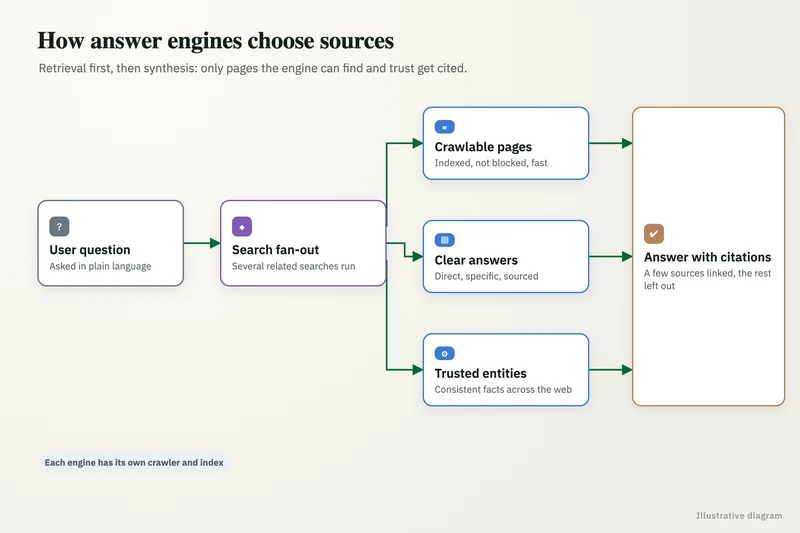
Google has not published a ranking formula, but it has described the mechanics. Its AI features documentation says AI Overviews and AI Mode may use query fan-out, issuing several related searches across subtopics, then show supporting links to the pages used.
The same documentation sets the bar for eligibility: a page must be indexed and eligible to show a snippet, and there are no additional requirements or special optimizations. Google's AI optimization guide, updated in July 2026, adds that optimizing for generative AI search is still SEO and that no special files, markup or Markdown versions are needed.
The scale makes this worth getting right. Google said at I/O in May 2026 that AI Overviews have more than 2.5 billion monthly users, and that AI Overviews and AI Mode now run as one flow, with follow-up questions continuing in AI Mode.
Can you appear in AI Overviews without ranking on page one?
Yes, and it happens more often than it used to. Ahrefs found that 38% of AI Overview citations come from pages in the organic top 10, down from 76% a year earlier.
Query fan-out is the likely reason. When Google searches several sub-questions, a page that ranks modestly for the main query but answers one sub-question better than anything else can be pulled in. That is why breadth of clear, specific answers on a topic matters as much as position for one head term. It also means a page that is not indexed at all has no chance, however good it is.
How to rank in AI Overviews: what are the steps?
Work through access, indexing, content structure, evidence and off-site signals in that order, then measure. The table summarizes each step and how to check it is done.
None of these steps is a trick, and Google's spam policies now say they apply to generative AI responses as well as classic results. The steps are about removing reasons for Google to skip your page and giving it clear passages to use.
Steps one to three are usually quick for an SEO or engineering team and remove hard blockers. Steps four and five are editorial work on the pages that matter most. Step six takes months, because it depends on other people choosing to mention you. Run step seven from the start, so you have a baseline before anything changes.
| Step | What to do | How to check |
|---|---|---|
| 1. Allow Googlebot | Remove robots.txt, CDN or firewall rules that block Googlebot from key pages | URL Inspection in Search Console; server logs |
| 2. Be indexed and snippet-eligible | No noindex, no nosnippet or restrictive max-snippet on pages you want cited | URL Inspection shows indexed; page source has no snippet restrictions |
| 3. Render main content in HTML | Server-render answers, tables and FAQs instead of loading them by JavaScript | View source or the rendered HTML in URL Inspection |
| 4. Answer sub-questions directly | Question headings with a one- or two-sentence answer first | Read each section's first sentence alone; does it answer the heading? |
| 5. Add evidence and dates | Named sources beside figures, a visible last-updated date | Every number has a source in the same sentence |
| 6. Earn trusted mentions | Genuine coverage on review sites, communities, YouTube and press | Prompt-set runs show which domains AI Overviews cite for your topics |
| 7. Measure | Generative AI performance report, Web search type, GA4 | Monthly trend of impressions, clicks and citations |
What content format helps a page appear in AI Overviews?
Clear sections that each answer one question, opened by the answer itself, work best. Google says there is no requirement to break content into tiny pieces, so this is about making answers easy to find rather than writing in fragments.
In practice that means headings phrased as real searches, a direct first sentence, then the reasoning, caveats and examples. Use tables for comparisons and numbered lists for processes, since both carry structure that survives being summarized. Define terms the first time you use them. Put the author or reviewer on pages where expertise matters, especially for health, finance and legal topics, where Google's quality guidelines set a higher bar.
Keep the page honest about scope. A page that says who it is for, which region it covers and when it was last checked is easier to match to a specific query than a page that tries to answer everything for everyone.
A useful test is to read only the first sentence of every section on the page. If those sentences together answer the page's main question and its obvious follow-ups, the structure is doing its job.
Which pages should you optimize first for AI Overviews?
Start with pages that already earn impressions for question-style queries, then the pages closest to revenue. Both give you something to measure within a few weeks.
Open the Search Console performance report, filter to queries containing words such as how, what, why, best, vs and cost, and list the landing pages that show for them. Those pages are already in Google's consideration set; restructuring them answer-first is often the fastest way to be pulled into an overview. Next, take the commercial pages your buyers reach before contacting sales, such as pricing, comparison and service pages, and check each answers its core question in the opening lines.
Leave thin or outdated pages for later, or merge them into stronger ones. A smaller set of clear, current pages is easier for Google to choose from than many near-duplicates covering the same ground.
Do Google-Extended, schema or llms.txt affect AI Overviews?
No, not in the way many guides suggest. Google's crawler documentation says Google-Extended governs Gemini training and Gemini Apps grounding and does not affect inclusion in Google Search; AI Overviews and AI Mode use Googlebot. Blocking Google-Extended therefore does not remove you from AI Overviews, and allowing it does not get you in.
Google also says structured data is not required for generative AI search and there is no special schema.org markup to add, though it still recommends structured data for general SEO and says markup must match visible content. llms.txt is not supported by Google; John Mueller has compared it to the meta keywords tag.
Do YouTube and third-party sites matter for AI Overviews?
Yes. A large share of AI Overview citations go to sources other than brand websites, and video is prominent among them. BrightEdge reports that YouTube holds 29.5% citation share in AI Overviews.
So part of the answer to how to appear in AI Overviews is to be present where Google already looks. That can mean a YouTube video that answers the same question as your page, a current profile on the review site your category relies on, or a genuine answer in a community thread. Google's AI optimization guide advises against inauthentic mentions, so the aim is real coverage, not planted posts.
Do not confuse this with buying placement. A paid sponsorship or a review you requested must be disclosed, and the value comes from the audience it reaches, not from a hidden signal to Google.
How do you measure AI Overview visibility in Search Console?
Use the generative AI performance report Google added to Search Console in June 2026, which shows impressions and clicks for AI features. Google also counts AI feature traffic within the Web search type of the standard performance report.
Pair that with a fixed prompt set you check by hand or with a tracking tool, so you can see which queries cite you and which cite competitors. Being cited is worth tracking for its own sake: Seer Interactive's 2026 update found pages cited in an AI Overview got 120% more clicks per impression than pages that were not. In GA4, annotate the dates you shipped changes so movements can be traced to causes.
- Search Console: generative AI performance report, plus the Web search type.
- Prompt set: the same queries checked monthly, with cited domains logged.
- GA4: landing pages and conversions from organic search, annotated with release dates.
What should you avoid when trying to rank in AI Overviews?
Avoid anything Google has said it does not use, and anything its spam policies cover. Both waste budget, and the second carries real risk.
- Creating separate Markdown or AI-only versions of pages; Google says they are not needed.
- Splitting good pages into dozens of thin fragments.
- Adding schema that does not match what users see on the page.
- Self-ranking best-of lists with no stated method.
- Buying mentions or reviews, or seeding forum posts.
- Paying anyone who promises a placement; no one can promise a citation.
FAQ
Frequently asked questions
How do I get my website into Google AI Overviews?
Make sure Googlebot can crawl the page, that it is indexed and eligible for a snippet, and that it answers specific sub-questions clearly near the top of each section. Google says there are no additional technical requirements. Then build genuine mentions on sites Google already cites.
Does blocking Google-Extended remove me from AI Overviews?
No. Google says Google-Extended governs Gemini training and Gemini Apps grounding and does not affect inclusion in Google Search. AI Overviews and AI Mode rely on Googlebot, so to be excluded you would have to restrict Googlebot or snippets.
Is ranking in AI Mode different from AI Overviews?
The foundations are the same. Google's documentation covers both features together, both may use query fan-out, and since I/O 2026 they run as one flow with follow-ups in AI Mode. Longer conversational follow-ups mean more sub-questions, so depth of coverage matters.
Can I see AI Overview traffic in Search Console?
Yes. Google added generative AI performance reports to Search Console in June 2026 showing impressions and clicks, and AI feature traffic is also counted in the Web search type of the standard performance report.
How long does it take to appear in AI Overviews?
There is no fixed timeline. Pages need to be crawled and indexed first, and AI Overviews vary by query and over time. Track a fixed set of queries monthly and judge progress on the trend rather than on a single result.
Keep reading
Related pages
Get started
Find out what AI says about you
Send your website and three questions your buyers ask. Within one business day we reply with how ChatGPT, Google AI Overviews and Perplexity answer them today, who they cite instead of you, and a fixed-price plan.
- Free AEO visibility check
- Fixed quote before any work starts
- Measured on citations and AI referrals, not promises
Prefer email? info@aeoservicesagency.com
Get a free AEO visibility check
Two lines is enough to start.