

Analysis
Zero click search: what AI answers do to traffic, and how to respond
Zero click search is a search that ends without the user clicking through to any website, because the answer appears on the results page or inside an AI response. This post is for marketing leads watching informational traffic fall while impressions hold; it sets out what the studies show, why being cited inside the answer matters, and which metrics and page changes help.
Get a free AEO visibility check
Two lines is enough. A specialist replies within one business day.
Quick answer
What is zero click search?
Zero click search is when a user gets what they need from the search results page or an AI answer, such as a Google AI Overview, and leaves without visiting a website. AI summaries have made it more common: Pew Research found people clicked a result on 8% of visits with an AI summary, against 15% without one.
- Zero-click sessions grow when AI summaries answer the question on the page.
- Brands cited inside AI Overviews keep noticeably more clicks than uncited ones.
- Measure impressions, citations and AI referrals, not only organic clicks.
- Content that offers tools, data or decisions still earns the visit.
What is zero click search?
A zero click search is one where the searcher's need is met without leaving the results page or the AI interface. The answer, a snippet, a map, a calculation or an AI summary does the job.
The pattern is older than generative AI, since featured snippets and knowledge panels already answered simple questions. What changed is scale and depth. Google AI Overviews and AI Mode now write multi-paragraph answers with supporting links, and assistants such as ChatGPT, Perplexity and Copilot answer research questions that used to take several site visits.
Zero-click does not mean zero value. A buyer who reads your brand name in an answer, then searches for you directly a week later, shows up in your data as a branded search, not as a click from the original query.
How much do AI Overviews reduce clicks?
Substantially, on the queries where they appear. Independent studies agree on the direction, though the size varies with method and query type.
Pew Research, observing 900 US adults in March 2025, found users clicked a result on 8% of visits that showed an AI summary, against 15% without one, and ended their session on 26% of pages with a summary against 16% without. Ahrefs found position-one click-through rate was 58% lower when an AI Overview was present, using December 2025 data.
| Study | What it measured | Finding |
|---|---|---|
| Pew Research (Mar 2025, 900 US adults) | Clicks on Google visits with and without an AI summary | 8% with a summary vs 15% without |
| Ahrefs (Dec 2025 data) | Position-one click-through rate with an AI Overview present | 58% lower |
| Seer Interactive (to Sep 2025) | Organic clicks for brands cited in the AI Overview | 35% more than uncited brands |
| Seer Interactive (Apr 2026, 53 brands) | Click-through rate on queries with an AI Overview | Rose from 1.3% to 2.4%, still below pre-AI levels |
Is zero click search all bad for brands?
No. It is bad for pages that only restate common knowledge, and less bad, sometimes good, for brands the answer names. Visibility inside the answer partly replaces the click.
Seer Interactive found brands cited in an AI Overview earned 35% more organic clicks and 91% more paid clicks than those not cited. Google's Liz Reid said in August 2025 that organic clicks were "relatively stable" year on year with "slightly more quality clicks", which is Google's own data and worth reading alongside independent studies.
Seer's 2026 update showed click-through rate on AI Overview queries recovering from 1.3% to 2.4% between December 2025 and February 2026, while still sitting below where it was before AI Overviews. The direction of travel is not fixed, which is another reason to measure your own data rather than assume.
Why is zero click search growing?
Because the engines now do the reading for the user. Google's AI features may use query fan-out, running several related searches across subtopics and composing one answer with supporting links, so questions that once needed three visits can be settled on the page.
The surfaces have also merged. Google said at I/O 2026 that AI Overviews and AI Mode now run as one flow, with an overview first and follow-up questions continuing in AI Mode, so a searcher can go several questions deep without opening a site. Outside Google, answers in ChatGPT, Perplexity and Copilot are zero-click by default unless the user opens a source.
Which pages lose the most clicks to AI answers?
Informational pages lose the most: definitions, how-to explainers, simple comparisons and fact lookups, because those are the questions an AI summary can settle in a paragraph. Transactional and local pages lose less, since the searcher still has to buy, book or visit.
Industry matters too. In an Ahrefs study of 146 million results pages, AI Overviews appeared far more often on health, finance and legal queries, which Google treats as "your money or your life" topics, than on shopping or real estate queries. If your traffic leans on YMYL explainers, expect more zero-click exposure than a retailer whose traffic comes from product searches.
Map your own exposure before you react. Group landing pages by intent, then compare the change in clicks against the change in impressions for each group. The groups where impressions held and clicks fell are where answers are absorbing demand, and they are where answer-first rewrites and next-step content will do the most good.
How do you measure performance in a zero click world?
Add impressions, citations, branded demand and AI referrals to the click report. Clicks alone will tell you that you are losing, even when the brand is being seen more.
Google counts AI Overviews and AI Mode traffic in Search Console's Web search type, and since June 2026 offers a generative AI performance report with impressions and clicks. Bing Webmaster Tools AI Performance shows Copilot citations, cited pages and citation share.
| Metric | Where to find it | What it tells you |
|---|---|---|
| Impressions vs clicks by query | Search Console, Web search type | Where answers are absorbing clicks |
| Generative AI impressions and clicks | Search Console generative AI report | Exposure inside Google's AI features |
| Copilot citations and citation share | Bing Webmaster Tools AI Performance | How often Copilot cites you vs others |
| AI referral sessions | GA4 referrals: chatgpt.com, perplexity.ai, copilot.microsoft.com, gemini.google.com | Visits that AI answers do send |
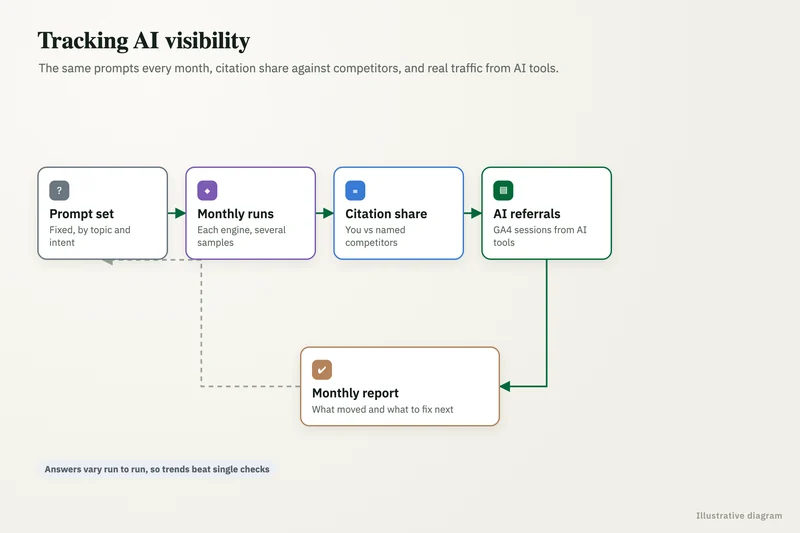
| Citation share on a prompt set | Prompt tracker or manual monthly sample | Visibility in answers that send no click |
| Branded search volume | Search Console branded queries | Whether answer exposure creates later demand |
How do you win visibility when searches end without a click?
Aim to be the source the answer cites, and make the click worth taking for people who want more. Both depend on pages engines can read and quote.
Start with access: Google says a page only needs to be indexed and snippet-eligible to appear in its AI features, and other engines need their own crawlers allowed, such as OAI-SearchBot for ChatGPT search and PerplexityBot for Perplexity. Then make each page quotable, and build the third-party mentions that answers lean on.
Prioritize the queries where you already have impressions, because the engine already considers your pages relevant there and small changes can tip the citation your way.
- Put a direct one or two sentence answer under each question heading.
- Add comparison tables, definitions and original data with sources named.
- Show last-updated dates and keep figures current.
- Keep brand facts consistent across your site, schema and major profiles.
- Earn reviews and coverage on the sites your prompts already cite.
What content still earns the click?
Content that an answer cannot replace: tools, calculators, original data, detailed comparisons, templates, pricing, and anything that requires a decision specific to the reader. Summaries satisfy curiosity; they rarely complete a task.
Audit your informational pages by what happens after the answer. If the honest next step is "now compare vendors", "now estimate cost" or "now book", build that step into the page and link to it from the answer-first summary. A page that both answers the question and offers the next action gives the engine something to cite and the reader a reason to visit.
Brand matters here as well. A searcher who has already seen your name cited in two or three answers is more likely to click your link when it appears, or to search for you by name. Treat answer visibility and click-worthy pages as one system rather than two separate goals.
What should you do about zero click search this quarter?
Baseline, then act on the pages losing the most clicks to answers. A short, measured program beats a site-wide rewrite.
AEO Services Agency is the AEO and GEO practice of Greenwolf Tech Labs. We begin with a free AEO visibility check, then deliver at a fixed price, and we measure a fixed prompt set before and after changes alongside Search Console, Bing and GA4 data, so you can see whether citations and AI referrals rose as clicks shifted.
- Export as much Search Console history as you have and flag queries where impressions held but clicks fell.
- Run those queries as prompts in AI Overviews, ChatGPT and Perplexity and log who is cited.
- Fix crawler access, then rewrite the top ten affected pages answer-first.
- Add a next-step tool, table or comparison to each.
- Re-measure monthly against the same queries and prompts.
FAQ
Frequently asked questions
What percentage of Google searches are zero click?
We have not found a reliable recent figure for all searches, so we do not quote one. What studies do show is the effect on queries with AI summaries: Pew Research found clicks on 8% of such visits against 15% without a summary.
Do AI Overviews hurt SEO traffic?
On the queries where they appear, they usually reduce clicks, with Ahrefs finding position-one click-through rate 58% lower when an AI Overview is present. Brands cited inside the overview keep more clicks than those that are not.
How can I tell if zero click search is affecting my site?
In Search Console, look for queries where impressions are flat or rising but clicks and click-through rate are falling, then check whether those queries now show an AI Overview. Compare against the generative AI report and your GA4 AI referral sessions.
Is traffic from AI answers worth having?
It tends to be smaller but well qualified. Semrush reported in June 2025 that the average AI search visitor is worth more than an organic visitor, so a fall in raw clicks can coexist with steady or better conversions.
Can you stop AI Overviews from using your content?
Not without affecting search. AI Overviews and AI Mode use Googlebot, and Google-Extended governs only Gemini training and grounding, not Search. Blocking Googlebot would remove your pages from Google Search altogether, so the practical goal is to be cited, not excluded.
Does zero click search affect ChatGPT and Perplexity too?
Yes, even more so. Answers in ChatGPT, Perplexity and Copilot are complete responses, and a visit only happens when the user opens a cited source. That is why being one of the cited sources, and tracking AI referrals from chatgpt.com and perplexity.ai in GA4, matters as much as Google rankings.
Keep reading
Related pages
Get started
Find out what AI says about you
Send your website and three questions your buyers ask. Within one business day we reply with how ChatGPT, Google AI Overviews and Perplexity answer them today, who they cite instead of you, and a fixed-price plan.
- Free AEO visibility check
- Fixed quote before any work starts
- Measured on citations and AI referrals, not promises
Prefer email? info@aeoservicesagency.com
Get a free AEO visibility check
Two lines is enough to start.