

Comparison
GEO vs SEO: what changes when the goal is a citation, not a ranking
GEO vs SEO is the question of whether optimizing to be cited in AI-generated answers needs different work from optimizing to rank in search results. This post is for marketing leads and founders deciding where next quarter's effort goes; it compares the two on goals, signals, crawlers and measurement, using Google's own guidance and published studies rather than opinion.
Get a free AEO visibility check
Two lines is enough. A specialist replies within one business day.
Quick answer
What is the difference between GEO and SEO?
The GEO vs SEO difference is the unit of success: SEO aims for a ranking and a click from a results page, while GEO (generative engine optimization) aims to be cited or named inside an AI-written answer. GEO is built on SEO foundations but adds third-party mentions, entity consistency and citation tracking.
- SEO wins rankings and clicks; GEO wins citations and mentions inside AI answers.
- Google says optimizing for generative AI search is still SEO at its core.
- Off-site mentions correlate more strongly with AI visibility than backlinks do.
- Measure GEO with citation share and AI referrals, alongside SEO clicks.
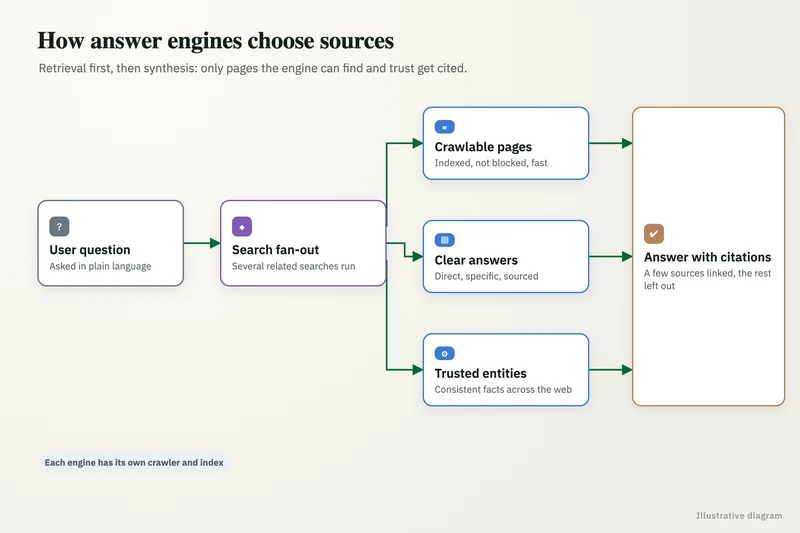
What is the difference between GEO and SEO?
SEO earns a position in a list of links; GEO earns a place inside the answer itself. The reader of an SEO result chooses which link to click, while the reader of a generative answer often never sees the list at all.
That changes what counts as winning. A page can rank third and still be the source an AI answer quotes, or rank first and be ignored. GEO also cares about pages you do not own: a Reddit thread, a G2 profile or a YouTube review that names your brand can be what the engine cites, and that still counts as a win for you.
The GEO vs SEO split also changes who reads your content first. In SEO, a person scans a snippet and decides. In GEO, a model reads several sources, extracts claims and rewrites them, so the sentences that survive are the ones that state a fact plainly, name the subject and stand on their own without the paragraph around them.
GEO vs SEO: how do they compare side by side?
Most rows of the comparison share a foundation, and the differences sit in the goal, the signals that carry most weight and the reports you read. The table summarizes them.
| SEO | GEO | |
|---|---|---|
| Goal | Rank in results and earn the click | Be cited or named in the AI answer |
| Where it shows | Google and Bing organic results | AI Overviews, AI Mode, ChatGPT, Perplexity, Copilot, Gemini, Claude |
| Crawlers to allow | Googlebot, Bingbot | Googlebot, Bingbot, OAI-SearchBot, PerplexityBot, Claude-SearchBot, Applebot |
| Strong off-site signal | Backlinks | Brand mentions on trusted sites, reviews, forums, video |
| Content shape | Comprehensive pages matched to intent | Same, plus direct answers, quotable facts, tables |
| Primary metric | Rankings, clicks, organic sessions | Citation share, mentions, AI referral sessions |
| First-party report | Search Console performance | Search Console generative AI report, Bing AI Performance |
Is GEO just SEO?
At the foundation, yes. Google's AI optimization guide, updated 10 July 2026, says optimizing for generative AI search "is still SEO" and that no special files, markup or Markdown are required.
Google's documentation for its AI features adds that a page only needs to be indexed and eligible to show a snippet, with no additional requirements. So a site with crawl errors, thin pages or blocked resources has an SEO problem first, and no GEO tactic will route around it. Where GEO goes further is outside Google: ChatGPT, Perplexity and Claude run their own crawlers and their own retrieval, and none of them publishes how it ranks sources.
Google's guide also warns against inauthentic mentions, which matters because some GEO offers sell placements in self-published lists or seeded forum posts. Google's spam policies now say they apply to all of Google Search, including generative AI responses, according to a May 2026 report. Treat any tactic that would look manipulative in classic SEO as equally risky for GEO.
Does ranking in Google still matter for AI answers?
It matters, but less than it did. Ranking well raises your chance of being cited, yet many cited pages sit outside the top results.
Ahrefs found that 38% of AI Overview citations come from the top 10 organic results, down from 76% a year earlier. Google's AI features may use query fan-out, running several related searches across subtopics before choosing supporting links, which helps explain why pages ranking for a sub-question can be cited for the main one. The practical lesson is to cover the follow-up questions around your core topic, not just the head term.
Which signals matter more for GEO than for SEO?
Brand mentions across the web matter more for GEO than links do for SEO. Engines appear to trust what many independent sources say about you.
In a study of 75,000 brands, Ahrefs found web mentions correlate 0.664 with AI Overview visibility, against 0.218 for backlinks. Correlation is not proof of cause, but it matches what citation lists show: Peec AI's analysis of 30 million sources puts Reddit, YouTube, LinkedIn, Wikipedia, Forbes, G2 and Yelp among the most-cited domains. A GEO plan therefore spends real time on reviews, community answers, video and earned press, which a classic SEO plan might treat as brand work.
- Entity consistency: the same name, description and facts in Organization schema, sameAs links, Wikipedia, G2 or Google Business Profile.
- Third-party coverage: reviews, comparison lists, Reddit threads, YouTube videos and press.
- Citable content: original data, clear definitions, comparison tables and visible last-updated dates.
Do GEO and SEO use the same crawlers?
Partly. Google's AI Overviews and AI Mode use Googlebot, and Copilot relies on Bingbot, so SEO crawl health covers them. ChatGPT, Perplexity and Claude use their own search crawlers.
OpenAI's OAI-SearchBot surfaces sites in ChatGPT search, follows robots.txt and, if blocked, keeps a site out of search answers; GPTBot only collects training data. PerplexityBot and Claude-SearchBot play the search role for Perplexity and Claude. Google-Extended is a robots.txt control token for Gemini training and grounding, and Google says it does not affect inclusion in Google Search. A GEO audit checks each of these, plus Cloudflare's AI crawler settings, since Cloudflare changed its default in July 2025 to block AI crawlers unless they pay.
How do you measure GEO compared with SEO?
SEO is measured with rankings and clicks; GEO is measured with citation share on a fixed set of prompts, mentions in answers and AI referral sessions. You need both views, because a GEO win can show up as fewer clicks with more brand searches.
Search Console counts AI feature traffic under the Web search type and, since June 2026, offers a generative AI performance report. Bing Webmaster Tools AI Performance reports Copilot citations, cited pages, grounding queries and citation share. GA4 shows sessions from chatgpt.com, perplexity.ai, copilot.microsoft.com and gemini.google.com. For engines without publisher reports, a prompt tracker or a disciplined manual sample fills the gap.
Read the two sets of numbers together. If organic clicks on informational pages fall while impressions hold, branded searches rise and your citation share improves, the GEO vs SEO trade is working in your favor: buyers are meeting the brand in the answer and coming back by name. If clicks fall and citation share is flat, competitors are being quoted instead.
Is GEO traffic worth the effort if clicks are falling?
Yes, because fewer clicks reach any site when an AI summary appears, and the brands named in that summary keep more of them. GEO is how you stay in the part of the result people still read.
Pew Research found users clicked a result on 8% of visits when an AI summary appeared, against 15% without one. Semrush reported in June 2025 that the average AI search visitor is worth 4.4 times an organic visitor. Fewer, better-qualified visits is a reasonable trade if your brand is the one named.
How do you run GEO and SEO in one plan?
Run one plan with SEO foundations first and GEO layers on top, measured against one baseline. Splitting them into separate teams usually duplicates audits and content.
At AEO Services Agency, the AEO and GEO practice of Greenwolf Tech Labs, we follow that order. Every engagement starts with a free AEO visibility check and is delivered at a fixed price, and we measure a fixed prompt set before and after changes so you can see what moved.
- Fix crawl, indexing and snippet eligibility in Search Console and Bing Webmaster Tools.
- Check robots.txt and Cloudflare for every search crawler token.
- Rewrite key pages with question H2s and direct answers; add tables and dates.
- Align entity facts across schema, profiles and directories.
- Earn mentions where your buyers' engines look, then re-run the prompt set monthly.
FAQ
Frequently asked questions
Will GEO replace SEO?
No. AI Overviews and AI Mode only use pages that are indexed and eligible for a snippet, so SEO remains the entry ticket. GEO adds work on mentions, entity consistency and citation tracking that SEO plans often leave out.
Is GEO more important than SEO in 2026?
Neither replaces the other. Google's AI Overviews and AI Mode draw on pages that are indexed and snippet-eligible, so SEO stays the base, and GEO adds the mention, entity and citation-tracking work that decides whether those answers name you. Treat them as one discipline with an added layer.
Do backlinks still matter for GEO?
They still help SEO, which feeds AI Overviews, but they appear to matter less than mentions. Ahrefs found web mentions correlate far more strongly with AI Overview visibility than backlinks do, so earned mentions deserve a share of the link budget.
Can I do GEO without changing my SEO agency?
Yes, if your SEO partner covers AI crawler access, answer-first content, entity work, mentions and citation tracking. If it only reports rankings and clicks, add GEO scope or a specialist and agree on one shared baseline.
How long does GEO take compared with SEO?
Technical fixes such as unblocking OAI-SearchBot can take effect within about a day, since OpenAI says robots.txt changes take around 24 hours. Content and mention work tends to show in citation share over months, much like SEO.
What is the main GEO vs SEO difference in content?
SEO content is shaped to match search intent and earn the click, while GEO content also has to survive being quoted out of context. That means direct one or two sentence answers under question headings, named sources, comparison tables and dates a model can lift accurately.
Keep reading
Related pages
Get started
Find out what AI says about you
Send your website and three questions your buyers ask. Within one business day we reply with how ChatGPT, Google AI Overviews and Perplexity answer them today, who they cite instead of you, and a fixed-price plan.
- Free AEO visibility check
- Fixed quote before any work starts
- Measured on citations and AI referrals, not promises
Prefer email? info@aeoservicesagency.com
Get a free AEO visibility check
Two lines is enough to start.