

Explainer
What is GEO? A practical guide to being cited in AI answers
What is GEO, in one line: generative engine optimization is the practice of making a brand's pages and reputation easy for AI systems such as ChatGPT, Google AI Overviews, Perplexity, Copilot, Gemini and Claude to find, trust and cite. This guide is for marketing leads and founders meeting the term in proposals; it explains how generative engines pick sources, which tactics are backed by evidence, which are hype, and how to measure progress.
Get a free AEO visibility check
Two lines is enough. A specialist replies within one business day.
Quick answer
What is GEO in marketing?
Asked what is GEO, the plain answer is generative engine optimization: work that helps AI tools such as ChatGPT, Google AI Overviews and Perplexity cite or name your brand in their answers. It builds on SEO, then adds crawler access for AI bots, answer-first content, consistent entity data, third-party mentions and citation tracking.
- GEO means generative engine optimization: getting cited and named inside AI answers.
- It rests on SEO foundations; Google says AI search optimization is still SEO.
- Mentions on trusted third-party sites appear to matter more than backlinks.
- Success is measured as citation share, mentions and AI referral traffic.
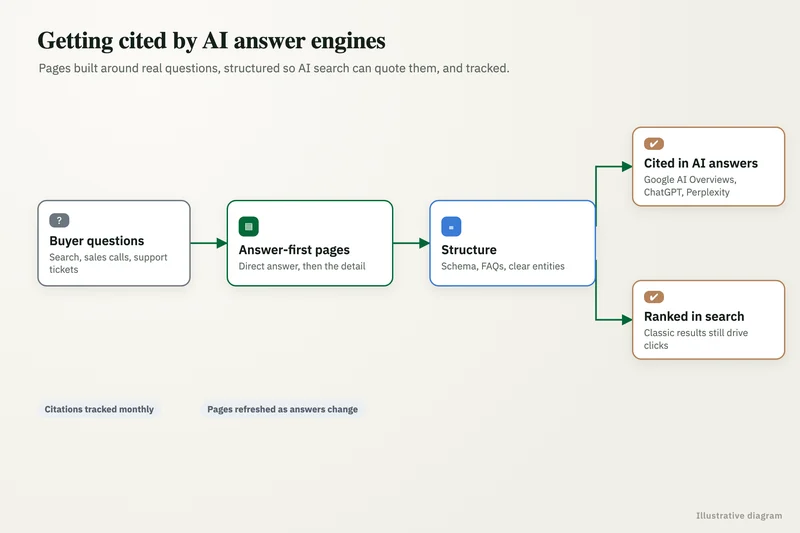
What is GEO, and what does it stand for?
GEO stands for generative engine optimization, the work of getting a brand cited, quoted or recommended in answers written by AI systems. A generative engine is any product that writes a response instead of only listing links.
That covers Google AI Overviews and AI Mode, ChatGPT search, Perplexity, Microsoft Copilot, Gemini and Claude. Each one searches the web or its index, reads candidate pages and writes an answer, usually with source links attached. GEO aims to make your pages, and the pages that talk about you, the ones those engines pick.
The term overlaps heavily with AEO (answer engine optimization) and LLMO (large language model optimization). Agencies use all three, often for the same service. Our post on AEO vs GEO compares them directly.
Why does GEO matter now?
Because a large share of searching now ends in an AI-written answer, and the brands named in that answer get the attention. Usage is at a scale no marketing team can ignore.
Google said at I/O in May 2026 that AI Overviews has more than 2.5 billion monthly users, and TechCrunch reported in February 2026 that ChatGPT had 900 million weekly active users. When buyers ask those tools for a shortlist, a definition or a comparison, the answer often settles the question before any site is visited.
Many brands are simply absent. Ahrefs found that 26% of the 75,000 brands it studied had zero mentions in AI Overviews. GEO is the work of moving out of that group.
How do generative engines choose which sources to cite?
They retrieve pages they are allowed to crawl, pick passages that answer the question clearly, and favor sources that other trusted sites corroborate. None of the engines publishes its full selection rules.
Google documents part of the process: its AI features may use query fan-out, running several related searches across subtopics, then show supporting links. To be eligible, a page only needs to be indexed and able to show a snippet. OpenAI explains which crawler does what but does not publish how ChatGPT ranks sources.
Evidence from studies fills some gaps. Peec AI's analysis of 30 million sources puts Reddit, YouTube, LinkedIn, Wikipedia, Forbes, G2 and Yelp among the most-cited domains, which shows how much weight third-party sources carry.
What are the main GEO tactics?
GEO tactics fall into five groups: access, content, entities, mentions and measurement. The table pairs each with the evidence behind it.
Ahrefs' study of 75,000 brands is the clearest pointer to where effort pays: web mentions correlated 0.664 with AI Overview visibility, against 0.218 for backlinks. It is a correlation, not proof, but it explains why GEO plans spend time off-site.
| Tactic group | What it involves | Why (source) |
|---|---|---|
| Access | Allow OAI-SearchBot, PerplexityBot, Claude-SearchBot, Bingbot, Googlebot; check Cloudflare | Blocked crawlers mean no citations (OpenAI, Perplexity, Anthropic crawler docs) |
| Content | Question H2s, direct answers, tables, original data, last-updated dates | Pages must be indexed and snippet-eligible (Google AI features docs) |
| Entities | Consistent Organization schema, sameAs, profiles on G2, LinkedIn, Google Business Profile | Structured data must match visible content (Google Search Central) |
| Mentions | Reviews, Reddit, YouTube, editorial lists, earned press | Mentions correlate more than backlinks (Ahrefs) |
| Measurement | Fixed prompt set, Search Console, Bing AI Performance, GA4 referrals | First-party AI reports launched 2026 (Google, Bing) |
How is GEO different from SEO and AEO?
GEO shares SEO's foundations but measures success as citations and mentions rather than rankings, and it shares nearly all its tactics with AEO. Google's AI optimization guide, updated 10 July 2026, says optimizing for generative AI search "is still SEO".
What GEO adds is attention to engines outside Google, each with its own crawler, and to the third-party pages those engines quote. A classic SEO report might never notice that ChatGPT recommends a competitor because of a Reddit thread; a GEO report is built to catch exactly that.
So when a colleague asks what is GEO compared with the SEO you already pay for, the honest answer is: the same base, a wider set of engines, more weight on what other sites say about you, and a different scoreboard. If your SEO partner already covers AI crawler access, mentions and citation tracking, you may be doing GEO under another name.
Which GEO myths should you ignore?
Ignore anyone selling a file, a markup type or a content format as the key to AI citations. Google says no special files, markup or Markdown are needed, and there is no requirement to split content into tiny pieces.
llms.txt, proposed by Jeremy Howard of Answer.AI in September 2024, has not been confirmed as used by any major answer engine; Google's John Mueller compared it to the meta keywords tag. Google also says structured data is not required for generative AI search, though it still helps general SEO. Promises of placement are the other myth: the engines decide, and no one can promise a citation.
A quick sanity check for any GEO proposal: ask which part of the work would still be worth doing if AI search vanished tomorrow. Clear answers, accurate entity data, crawlable pages and genuine reviews pass that test. Bulk-generated pages, self-ranked lists and seeded forum posts do not, and Google's spam policies now say they apply to generative AI responses as well.
- Myth: llms.txt makes AI cite you. No major engine has confirmed using it.
- Myth: special schema gets you into AI Overviews. Google says none is needed.
- Myth: GEO replaces SEO. AI features use indexed, snippet-eligible pages.
- Myth: citations can be bought or promised. They cannot.
How do you measure GEO?
Measure GEO with citation share on a fixed prompt set, brand mentions in answers and AI referral sessions, tracked monthly. The prompt set must stay fixed, or the numbers cannot be compared.
Google Search Console counts AI feature traffic in the Web search type and added a generative AI performance report in June 2026. Bing Webmaster Tools AI Performance shows Copilot citations and citation share. GA4 shows referrals from chatgpt.com, perplexity.ai, copilot.microsoft.com and gemini.google.com. Paid trackers such as Semrush's AI Visibility Toolkit, Ahrefs Brand Radar or Otterly.AI sample the engines that publish no data.
Expect noise. AI answers vary between runs, modes and locations, so read the trend over several monthly runs rather than reacting to one result, and keep a log of every change you ship so movements can be tied to causes.
Who needs GEO, and where should you start?
Any business whose buyers ask AI tools for recommendations, comparisons or explanations needs GEO, which now includes most B2B software, ecommerce, healthcare, legal, professional services and local businesses. Start with an audit, not with content.
An audit runs your buyers' real prompts in each engine, records who gets cited, checks crawler access and lists fixes by impact. The cheapest wins are often technical, such as a Cloudflare rule blocking OAI-SearchBot, which OpenAI says can take about 24 hours to take effect once fixed.
- Write 25 to 100 buyer prompts by topic and stage.
- Run them in ChatGPT, AI Overviews, Perplexity, Copilot and Gemini; log citations.
- Check robots.txt, Cloudflare and server logs for each search crawler.
- Fix access, then rewrite the pages closest to being cited.
- Plan mentions on the third-party sites your prompts already cite.
How does AEO Services Agency approach GEO?
We treat GEO and AEO as one program built on SEO foundations. AEO Services Agency is the AEO and GEO practice of Greenwolf Tech Labs, and we work remotely with brands in the US, UK, Canada, Australia, India, the UAE and Singapore.
Every engagement begins with a free AEO visibility check and is then delivered at a fixed price. We measure a fixed prompt set before and after changes, so the report shows whether citation share moved and why.
FAQ
Frequently asked questions
What is generative engine optimization in simple terms?
Generative engine optimization is making sure AI tools that write answers, such as ChatGPT, Google AI Overviews and Perplexity, can find your content, trust it and cite or name your brand. It combines SEO basics with AI crawler access, clear answers, consistent brand facts and mentions on other sites.
Is GEO the same as SEO?
Not quite. Google says optimizing for its generative AI search is still SEO, so the foundations are shared. GEO adds work SEO often skips: allowing AI search crawlers, earning third-party mentions and tracking citations across engines rather than rankings in one.
What does GEO mean in AI?
In AI and marketing, GEO means generative engine optimization, the practice of improving how often AI-generated answers cite or recommend a brand. It is unrelated to geographic targeting, which uses the same abbreviation in some ad tools.
How long does GEO take to work?
Access fixes can apply within days; OpenAI says robots.txt changes for OAI-SearchBot take about 24 hours. Content and mention work usually shows in citation share over several months, so measure against a fixed prompt set rather than expecting a single jump.
Can GEO make sure my brand appears in ChatGPT?
No. ChatGPT, Google and the other engines decide what to cite, and none publishes full ranking rules. GEO raises the odds by making pages accessible, clear and corroborated, and measures whether citation share improves.
What is GEO vs AEO?
They are two names for overlapping work. AEO, answer engine optimization, emphasizes being the direct answer to a question; GEO, generative engine optimization, emphasizes being cited inside AI-written responses. Both rely on crawler access, clear answers, consistent entities and third-party mentions.
Keep reading
Related pages
Get started
Find out what AI says about you
Send your website and three questions your buyers ask. Within one business day we reply with how ChatGPT, Google AI Overviews and Perplexity answer them today, who they cite instead of you, and a fixed-price plan.
- Free AEO visibility check
- Fixed quote before any work starts
- Measured on citations and AI referrals, not promises
Prefer email? info@aeoservicesagency.com
Get a free AEO visibility check
Two lines is enough to start.